
Coronary Artery Disease in Women: Symptoms, Risk Factors and Prevention
Quick answer Chest discomfort remains the most common heart-attack symptom in women, but women are more likely to experience additional


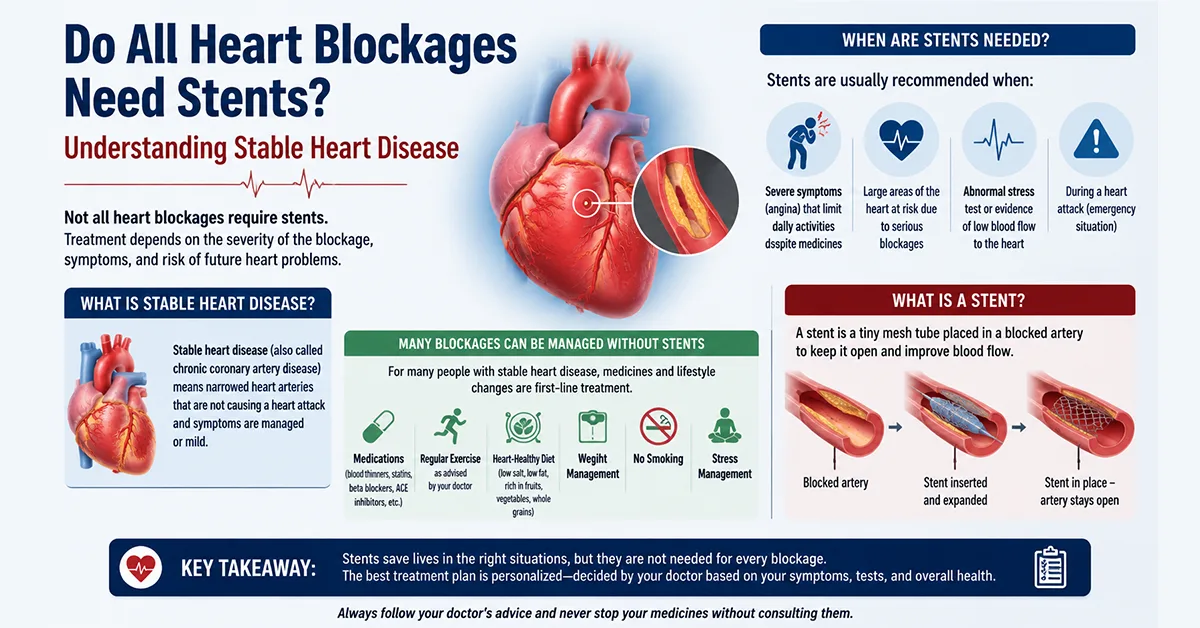
Heart disease continues to be one of the leading causes of death worldwide. Emergency procedures like angioplasty and stenting have undoubtedly saved millions of lives during heart attacks. But today, an important medical question is gaining attention globally:
According to multiple international studies and reports referenced by organizations like the Parsemus Foundation and the American Medical Association (AMA), stenting in stable coronary artery disease may often provide limited long-term benefit for many patients — especially when compared to lifestyle modification and medical management.
In many non-emergency cases, patients may be undergoing invasive procedures even when non-invasive heart treatment approaches could be explored first.
A stent is a small mesh tube placed inside a blocked artery to restore blood flow to the heart.
In emergency situations such as:
Stenting can be life-saving.
However, in stable heart disease, where blockages are present but symptoms are manageable, research suggests that medicines, lifestyle correction, and risk-factor management may sometimes be equally effective.
Several landmark clinical studies have changed the way the medical world views stenting for stable coronary artery disease.
Published in the New England Journal of Medicine, the COURAGE Trial found that stenting did not significantly reduce the risk of heart attack or death compared to optimal medical therapy alone in stable patients.
Published in The Lancet, the ORBITA Trial showed that in some stable patients, stents did not produce significantly better symptom relief compared to placebo procedures.
Reports discussed by the Parsemus Foundation and the American Medical Association also highlighted concerns regarding unnecessary stenting in non-emergency situations.
Simply put:
For many stable heart patients, correcting lifestyle and improving overall metabolic health may be as important as procedures.
Despite growing evidence, stenting continues to be widely performed in stable patients.
Common reasons include:
But one important medical fact is often misunderstood:
Most heart attacks occur because of sudden blood clot formation, not just because of fixed blockage percentages.
While stenting is generally safe and extremely valuable in emergencies, it may not address the root cause of heart disease.
Stenting does NOT:
In many cases:
This is where Madhavbaug focuses on a different philosophy.
For over two decades, Madhavbaug has worked on an integrative, non-invasive cardiac care model that combines Ayurveda with modern medical science.
The goal is not just symptom management, but improving overall heart health and reducing disease progression.
Global cardiac research increasingly emphasizes:
This aligns closely with the integrative care philosophy followed at Madhavbaug.
Addressing Root Causes
Focus on:
Structured Lifestyle Programs
Programs include:
Ayurvedic Therapies
Therapies may include:
These approaches aim to:
Real Impact Seen in Patients
Many patients who had:
have reported improvements through structured lifestyle correction and integrative cardiac rehabilitation.
Patients often experience:
Most importantly, they move toward long-term heart health instead of depending only on procedures.
Modern science and traditional wisdom are increasingly pointing toward the same conclusion:
Heart disease is not only a blockage problem — it is deeply connected to lifestyle, metabolism, stress, and inflammation.
While stents remain essential during emergencies, stable heart patients should also explore:
Before opting for stenting in a non-emergency situation, patients should ask:
Today, with growing global evidence and integrative approaches like those followed at Madhavbaug, patients have more informed choices than ever before.
Your heart does not just need a procedure — it needs long-term care, healthier habits, and the right lifestyle.

Quick answer Chest discomfort remains the most common heart-attack symptom in women, but women are more likely to experience additional

Have you ever been through this situation wherein you had chest pain, you visited your doctor and they suggested an