
Coronary Artery Disease in Women: Symptoms, Risk Factors and Prevention
Quick answer Chest discomfort remains the most common heart-attack symptom in women, but women are more likely to experience additional


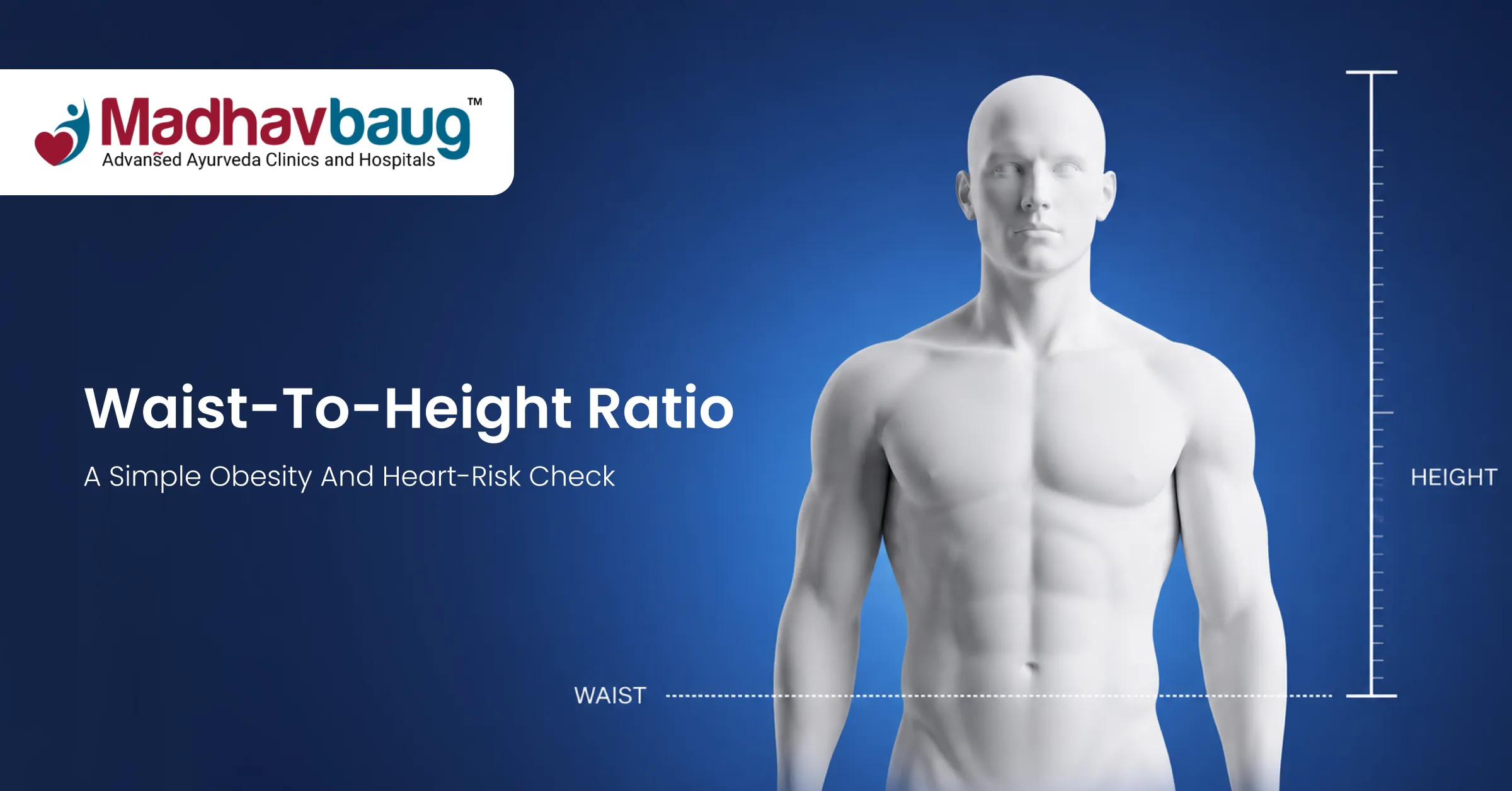
Tracking body weight is a good start, but weight alone cannot tell you the full story. It cannot show you where the fat is stored in your body, even though this fat is what actually influences your risk for Type 2 Diabetes, Hypertension (High Blood Pressure), and Heart Disease.
The Waist-to-Height Ratio helps solve this problem. It is a simple and easy calculation that measures your belly fat. Because of this, doctors are now using this calculation more often as a screening tool. While this ratio cannot directly diagnose a disease, it is very helpful in pointing out the fat patterns that may need a closer view.
This article explains how to measure your ratio correctly, what your results mean and how to use the waist-to-height ratio to get a better understanding of your health and related risks.
Waist-to-height ratio (WHtR) is a simple way of comparing your waist circumference with your height. The calculation takes less than a minute.
For example, a waist circumference of 85 cm and a height of 170 cm is 85/170 and gives a WHtR of 0.50. If you prefer not to calculate it manually, a waist-to-height ratio calculator can provide the result instantly once you enter the measurements.
That simple number can tell you how much fat has gathered in your belly area, especially around your internal organs. Since the calculation includes your height, the exact same waist size may mean different levels of health risk for people of different heights.
Clinical guidelines recommend having a waist circumference below half the total height, which is a waist-to-height ratio of less than 0.5 (National Institute for Health and Care Excellence, 2022).
Total body weight does not reveal where fat is stored, but the waist size does. That difference matters more than most people realise. Not all fat behaves the same way in the body. The layer stored just beneath the skin (subcutaneous fat) is generally less harmful. Visceral fat, the fat around internal organs, is far more concerning.
Visceral fat releases inflammatory chemicals and fatty acids directly into the bloodstream. It disrupts the hormonal balance and reduces insulin sensitivity.
The cumulative effect raises the risk of serious chronic conditions, including heart blockage and cardiovascular disease, and this can happen well before body weight gives any other indication that something is wrong. For the Indian population, this concern is even more serious. South Asians tend to collect higher levels of abdominal and visceral fat at lower Body-Mass Index (BMI, a simple calculation that uses your height and weight to estimate whether you are underweight, at a healthy weight, or overweight) levels than many other populations. Obesity-related health risks may therefore develop at BMI readings that would otherwise appear acceptable by standard measures (Misra et al., 2025).
Small errors in technique are easy to make, and they do affect the final figure. The steps below ensure the measurement is taken correctly.
For the waist measurement:
For height:
Divide the waist measurement by the height measurement. The result is the waist-to-height ratio. A waist-to-height ratio calculator can also do this instantly if preferred.
Once the ratio is calculated, the result can be read against the following ranges. (Note that these are screening indicators and are not complete diagnostic tools)
| WHtR Range | Risk Category | What It Suggests |
| Below 0.40 | Very low | Waist may be slimmer as per height |
| 0.40 to 0.49 | Acceptable | Lower cardiometabolic risk range |
| 0.50 to 0.59 | Increased risk | Belly fat storage needs attention |
| 0.60 and above | High risk | Significantly elevated cardiometabolic risk |
A waist-to-height ratio of 0.50 or above also does not confirm a disease but suggests that abdominal fat may be deposited at a level that carries a higher risk of conditions such as type 2 diabetes, high blood pressure, and heart disease.
Madhavbaug’s PowerMAP programme evaluates all other aspects like blood pressure, blood sugar, cholesterol levels, medical history, and lifestyle factors as well, rather than relying on a single measurement, which helps doctors develop a personalised treatment plan based on an individual’s overall health profile.
BMI has been the default measure of weight-related health risk for decades. It is calculated from body weight and height, and though it is a commonly referred-to tool, it has well-documented limitations.
Studies in cardiovascular and metabolic health have found WHtR to be a more reliable predictor of risk than BMI alone (Tewari et al., 2023; Chan et al., 2024).
The two measures work together and not against each other. BMI gives you a starting point, but waist-to-height ratio shows exactly where extra fat is stored and how closely it sits to your internal organs. When used together, these can give you a clearer picture of your health.
For a broader assessment of how weight and metabolic health interact, Madhavbaug’s approach to weight loss and obesity management looks beyond surface numbers to address root-cause metabolic imbalance.
Abdominal fat does not affect appearance alone. When too much abdominal fat is present, it may be directly linked to three of the most prevalent chronic conditions: type 2 diabetes, hypertension, and heart disease.
Type 2 Diabetes
Visceral fat, the one around internal organs, directly affects how the body processes insulin. As resistance builds, blood sugar becomes harder to control, and WHtR has shown stronger predictive value for diabetes than BMI (Tewari et al., 2023). Abdominal fat, diabetes and heart disease are closely connected and frequently share the same underlying cause.
High Blood Pressure
Visceral fat also raises blood pressure as it causes inflammation, fluid retention, and nervous system activity. Studies confirm WHtR is a more reliable screening tool for hypertension than BMI alone, especially in people with type 2 diabetes (Moosaie et al., 2021)
Heart Disease
Abdominal fat puts direct strain on the heart. An elevated WHtR was found to be linked to a higher risk of ischaemic heart disease (Feng et al., 2024).
The medical benefits of reducing excess weight extend well beyond appearance and into meaningful long-term disease prevention.
A WHtR result above 0.50 is not the final verdict; it can be a starting point. What matters more is what you do after that result.
Madhavbaug’s Ayurvedic weight management assessment and clinical approach work at the root of abdominal fat accumulation and bring together targeted therapies with medical supervision and real-time monitoring.
Cutting calories alone may not help in reducing the fat around your internal organs, as this kind of fat requires a different strategy.
Madhavbaug’s diet and nutrition plans are focused on slow-release carbohydrates and heart-healthy means. These diets are customised and personalised for the patient, and this approach is used for both weight loss and overall metabolic health.
Panchakarma
Panchakarma is Ayurveda’s system of therapeutic detoxification, designed to clear metabolic waste and restore the body’s natural balance.
Udwarthanam, a dry herbal powder massage used as part of Madhavbaug’s Panchakarma protocols, has demonstrated reductions in body weight, waist circumference, and lipid levels in clinical research (Mishra and Kumar, 2024).
Pranayama and Therapeutic Movement
Stress hormones play a direct role in abdominal fat accumulation. Kapalbhati and Anulom Vilom Pranayama work to help regulate hormones and improve blood flow to the abdominal region. Structured physical movement is calibrated to each individual’s capacity and runs alongside these practices to improve insulin sensitivity gradually.
Medical Supervision
Madhavbaug physicians monitor heart health, blood pressure, and metabolic markers throughout the programme. Madhavbaug’s 24/7 digital monitoring systems ensure that every clinical decision is based on real patient data throughout the programme.
Knowing the ratio is only the beginning. The more useful question is how often it should be reviewed. A major international consensus statement has proposed that waist circumference should be measured as routinely as blood pressure in clinical settings, given how strongly it relates to heart disease risk and long-term health outcomes (Ross et al., 2020).
The same guideline applies at home, where regular measurement costs nothing and takes under a minute.
As a practical guide:
How frequently to recheck depends entirely on your own situation. Someone actively managing a metabolic condition under medical supervision may benefit from more frequent monitoring. For those maintaining a healthy WHtR with no known risk factors, an annual measurement along with a routine health screening is a reasonable starting point.
When a waist-to-height ratio calculation is used along with a full clinical assessment, it becomes a genuinely useful tool for understanding metabolic and heart health risk before serious, chronic conditions develop. At Madhavbaug, this measurement forms part of a broader evaluation that considers blood pressure, blood sugar, cholesterol, body composition, and medical history together.
Book a consultation with a Madhavbaug specialist to understand your individual risk and the most appropriate next steps.
Can I have a normal BMI but still have a high waist-to-height ratio?
Yes, and this is more common than most people realise. A person can fall within a normal BMI range while carrying a good amount of visceral fat around the abdominal organs. This pattern, (sometimes referred to as metabolic obesity) carries a real health risk that BMI alone will not flag. The waist-to-height ratio is particularly useful in identifying this group early.
My waist is large, but I feel healthy. Should I still be concerned?
Visceral fat is often described as a silent risk factor precisely because it produces no obvious symptoms in its early stages. Conditions such as insulin resistance, rising blood pressure, and early changes in cholesterol levels can develop gradually without any real signs. A high WHtR in an otherwise well person is still a reason to seek a clinical assessment.
At what age should I start monitoring my waist-to-height ratio?
There is no fixed age to start, but regular monitoring from the age of 18 onwards is a reasonable practice for most adults. For anyone with a family history of diabetes, heart disease, or hypertension, beginning earlier and tracking the trend consistently over time is recommended.
What is an ideal waist-to-height ratio?
A WHtR below 0.50 is an accepted range for lower heart disease risk. It would mean that the waist circumference should be less than half of the total height. This has also been formally recommended as a screening boundary (National Institute for Health and Care Excellence, 2022).
What is the waist-to-height ratio methodology?
The methodology is straightforward. Measure the waist circumference at the midpoint between the bottom of the lowest rib and the top of the hip bone, with the tape held level and the breath released normally. Measure height without footwear. Divide the waist measurement by the height measurement, both in the same unit. The resulting figure is the WHtR. Consistency in technique matters most when tracking changes over time.

Quick answer Chest discomfort remains the most common heart-attack symptom in women, but women are more likely to experience additional

Have you ever been through this situation wherein you had chest pain, you visited your doctor and they suggested an