
Coronary Artery Disease in Women: Symptoms, Risk Factors and Prevention
Quick answer Chest discomfort remains the most common heart-attack symptom in women, but women are more likely to experience additional


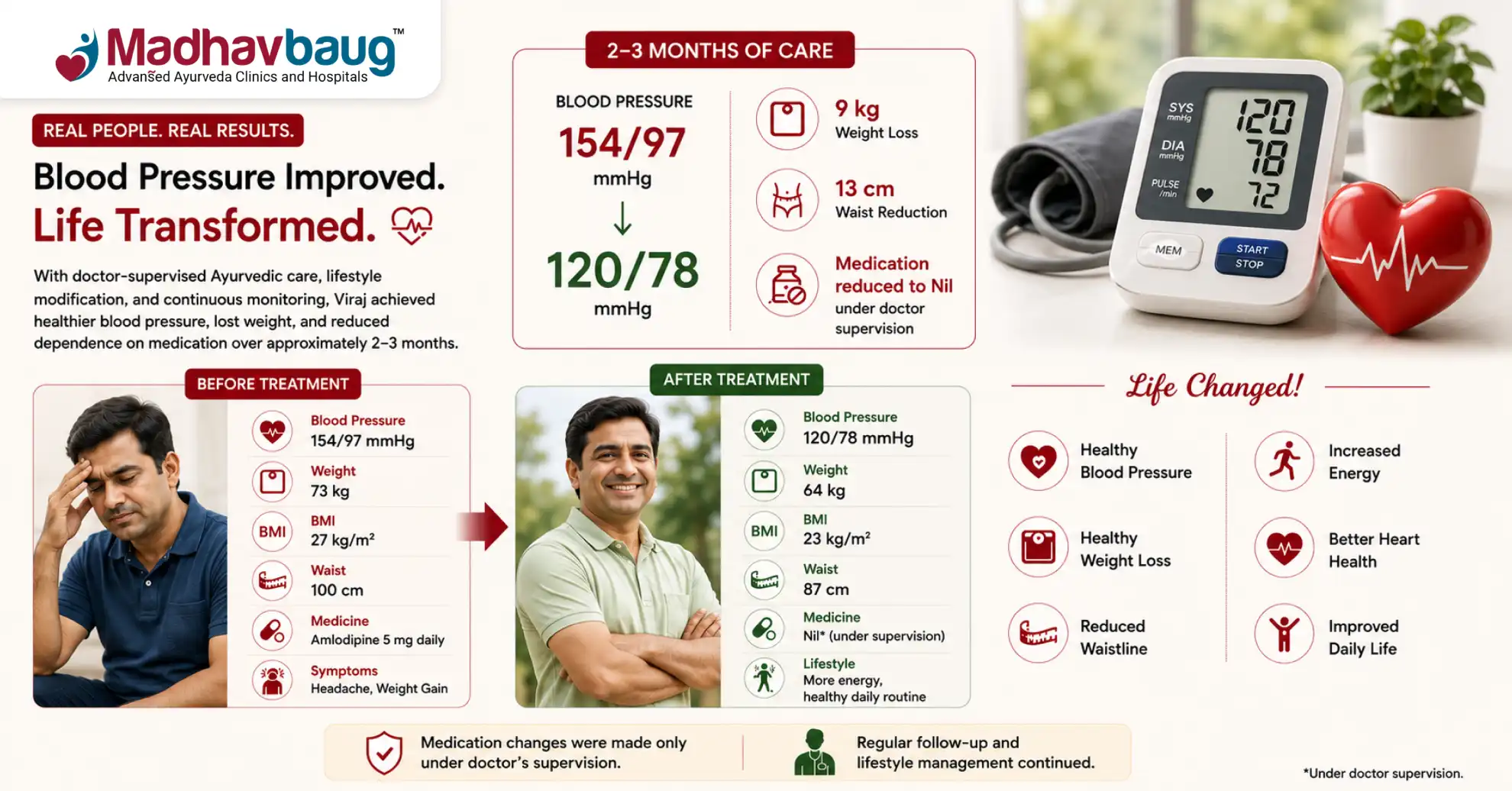
A real, doctor-supervised recovery, documented with before-and-after clinical results.
Viraj Pandit consulted Madhavbaug Goregaon East Clinic for hypertension, weight gain, and recurrent headache. At baseline, clinic blood pressure was 154/97 mmHg, weight was 73 kg, and abdominal girth was 100 cm. A personalised programme combining regular medical follow-up, doctor-prescribed SHS Panchakarma, dietary modification, herbal medicines, exercise, yoga, and continuous monitoring was initiated.
In the clinic comparison recorded after treatment, blood pressure improved to 120/78 mmHg, weight reduced to 64 kg, and abdominal girth reduced to 87 cm. Follow-up ambulatory blood pressure monitoring also showed improvement. Amlodipine was subsequently recorded as nil under medical supervision, with continued lifestyle follow-up.
| Parameter | Before | After |
| Clinic Blood Pressure | 154/97 mmHg | 120/78 mmHg |
| Weight | 73 kg | 64 kg |
| BMI | 27 kg/m² | 23 kg/m² |
| Abdominal Girth | 100 cm | 87 cm |
| LDL Cholesterol | 138 mg/dL | 101 mg/dL |
| Antihypertensive Medicine | Amlodipine 5 mg daily | Nil (under supervision) |
| Field | Details |
| Patient | Viraj Pandit |
| Location | Mumbai |
| Primary Diagnosis | Hypertension |
| Main Symptoms | Weight gain and headache |
| Clinic | Madhavbaug Goregaon East |
| Treating Doctors | Dr. Anuja Dalvi and Dr. Saloni Salvi |
| Clinical Guide | Dr. Bipin Gond, Zonal Medical Head |
| Duration | Approximately 2–3 months |
| Key Result | Blood pressure improved from 154/97 to 120/78 mmHg |
| Current Status | Blood pressure remained controlled at follow-up; medication recorded as ‘nil’ under doctor supervision |
Viraj Pandit was living with hypertension and taking amlodipine 5 mg once daily when she approached Madhavbaug Goregaon East Clinic. Her main concerns were weight gain and headache. Excess body weight and a 100 cm abdominal girth were important modifiable risk factors, while her elevated clinic blood pressure reading indicated that closer monitoring was required.
She wished to improve blood pressure control through a structured lifestyle programme and hoped, where clinically safe, to reduce dependence on allopathic medication under medical supervision. The treatment team focused on measurable goals: safer blood pressure readings, weight and waist reduction, improved cardiovascular risk markers, better energy, and sustainable daily habits.
| Symptom | Severity / Frequency | Impact on Daily Life |
| Weight gain | Clinically relevant: baseline weight 73 kg, BMI 27 kg/m² | Contributed to increased cardiovascular risk and reduced sense of fitness |
| Headache | Frequency not stated | Caused discomfort and was a concern given her high BP |
| Reduced energy | Reported before improvement | The patient later reported greater energy for daily chores. |
Viraj wanted better blood pressure control through lifestyle modification and wished to explore whether medication dependence could be reduced safely. She chose Madhavbaug for its integrated programme combining medical monitoring, diet, Panchakarma, exercise, yoga, herbal support, and supervised medicine coordination.
At entry, Viraj had known hypertension and was on tablet amlodipine 5 mg once daily. Clinic blood pressure was 154/97 mmHg, baseline weight was 73 kg, BMI was 27 kg/m², and abdominal girth was 100 cm. Despite medication, she remained concerned about blood pressure control, weight gain, and headache and was seeking a structured, supervised programme. Medicine changes were never self-directed; her medication was stopped only after clinical improvement and doctor review.
| Parameter | Baseline Value | Date |
| Clinic Blood Pressure | 154/97 mmHg | Baseline |
| Weight | 73 kg | Baseline |
| BMI | 27 kg/m² | Baseline |
| Abdominal Girth | 100 cm | Baseline |
| ABPM Day Average | 140/80 mmHg | 22 July 2025 |
| ABPM All-Time Average | 137/79 mmHg | 22 July 2025 |
| LDL Cholesterol | 138 mg/dL | Day 1 |
Viraj presented with hypertension, an elevated clinic BP of 154/97 mmHg, excess weight, a BMI in the overweight range, and central adiposity, with headache as her main symptom. Ambulatory blood pressure monitoring (ABPM) was used because it assesses blood pressure across daytime, night-time, and the full 24-hour period, rather than relying on a single clinic reading.
The treatment priorities were to achieve safer and more stable blood pressure readings, reduce weight and abdominal girth, improve cardiovascular risk markers, increase daily energy, and build sustainable lifestyle habits. A further goal was to review the need for amlodipine only after objective improvement was confirmed. Continued monitoring remained essential, since normal readings after treatment don’t mean hypertension can no longer recur, particularly if weight, diet, activity, sleep, or stress patterns deteriorate.
| Care Component | What Was Prescribed | Purpose |
| Diagnosis & Follow-Up | Clinic reviews with BP, weight, BMI, abdominal girth, and ABPM assessment | Track response and guide safe treatment decisions |
| Panchakarma / Therapy | Doctor-prescribed SHS Panchakarma | Support the integrated hypertension-management programme |
| Diet Plan | Structured Madhavbaug diet plan with lifestyle modification | Support calorie control, weight reduction, and BP management |
| Activity / Rehabilitation | Exercise and yoga | Improve fitness, energy, stress management, and long-term adherence |
| Medicine Coordination | Amlodipine 5 mg reviewed, later recorded as nil | Avoid unsupervised withdrawal and monitor BP stability |
The care plan was built around Viraj’s two major modifiable concerns: uncontrolled blood pressure and excess body weight. Regular clinic measurements and ABPM provided objective evidence of how her blood pressure behaved throughout the day and night. Dietary modification supported calorie control, reduced central adiposity, and improved overall cardiovascular risk, while exercise and yoga improved activity levels, stress regulation, and long-term adherence. Doctor-prescribed SHS Panchakarma and herbal medicines formed part of the integrated programme.
Importantly, amlodipine was not stopped at the patient’s discretion. The medicine need was reviewed by the treating doctors alongside symptoms, clinic BP, and ambulatory readings. As objective parameters improved, the case record documented no allopathic antihypertensive medicine at follow-up. Ongoing lifestyle adherence and periodic monitoring remain necessary, since hypertension can return even after a period of good control.
| Time Point | Objective Measure | Doctor Action |
| Baseline | BP 154/97 mmHg; weight 73 kg; waist 100 cm | Set BP, weight, and monitoring goals |
| Month 1 | Diet, SHS Panchakarma, exercise/yoga, and monitoring continued | Reviewed progress clinically |
| Day 60 | BP 120/78 mmHg; weight 64 kg; waist 87 cm | Medication status reviewed |
| Day 90 | Total cholesterol 183; TG 87; HDL 65; LDL 101 mg/dL | Cardiovascular risk markers reassessed |
| Latest Follow-Up (2 Nov 2025) | ABPM: day 131/79, night 117/69, all 129/78 mmHg | Continued monitoring, lifestyle maintenance reinforced |
| Parameter | Before | After | Change |
| Clinic Blood Pressure | 154/97 mmHg (Day 1) | 120/78 mmHg (Day 60) | −34/−19 mmHg |
| Weight | 73 kg (Day 1) | 64 kg (Day 60) | −9 kg |
| BMI | 27 kg/m² (Day 1) | 23 kg/m² (Day 60) | −4 kg/m² |
| Abdominal Girth | 100 cm (Day 1) | 87 cm (Day 60) | −13 cm |
| ABPM Day Average | 140/80 mmHg (22 Jul 2025) | 131/79 mmHg (2 Nov 2025) | −9/−1 mmHg |
| ABPM Night Average | 123/75 mmHg (22 Jul 2025) | 117/69 mmHg (2 Nov 2025) | −6/−6 mmHg |
| ABPM 24-Hour Average | 137/79 mmHg (22 Jul 2025) | 129/78 mmHg (2 Nov 2025) | −8/−1 mmHg |
| LDL Cholesterol | 138 mg/dL (Day 1) | 101 mg/dL (Day 90) | −37 mg/dL |
| Antihypertensive Medicine | Amlodipine 5 mg once daily | Nil at follow-up | Stopped under supervision |
The strongest recorded improvement was in clinic blood pressure, which reduced from 154/97 mmHg at baseline to 120/78 mmHg by Day 60. Weight reduced by 9 kg, BMI decreased from 27 to 23 kg/m², and abdominal girth reduced by 13 cm. The dated ABPM comparison also showed improvement, with the 24-hour average changing from 137/79 mmHg to 129/78 mmHg between 22 July and 2 November 2025. Lipid values at Day 90 showed total cholesterol reducing from 225 to 183 mg/dL and LDL from 138 to 101 mg/dL.
These results represent ther individual patient and should not be interpreted as a guaranteed response for others.
Viraj reported feeling more energetic and healthier after the programme. Daily chores could be completed with greater energy, and the overall outcome was satisfactory to her. The objective reductions in weight, waist circumference, and blood pressure supported her subjective improvement. Continued attention to diet, physical activity, yoga, stress management, and periodic BP monitoring remains important for maintaining these gains.
“I am very satisfied with the overall results. My blood pressure is well controlled, I feel healthier and more energetic, and I can complete my daily chores with much more energy.”
— Viraj Pandit
“The available records show improvement across clinic blood pressure, ambulatory blood pressure averages, body weight, BMI, abdominal girth, and selected lipid parameters. The outcome is clinically meaningful because blood-pressure improvement occurred alongside reduction in major modifiable risk factors. The medication status at follow-up was recorded as nil, but this should be understood as a doctor-supervised decision based on the patient’s individual response and not as advice for other patients to discontinue treatment. Viraj requires ongoing follow-up, periodic BP checks, and sustained lifestyle adherence. This single case cannot predict another patient’s response or replace an individual medical assessment.”
— Dr. Anuja Dalvi and Dr. Saloni Salvi, Treating Doctors
Clinical Guide: Dr. Bipin Gond, Zonal Medical Head
Viraj Pandit began the programme with hypertension, headache, weight gain, a clinic BP of 154/97 mmHg, and an abdominal girth of 100 cm. A personalised plan combining doctor follow-up, SHS Panchakarma, diet, herbal support, exercise, yoga, and continuous monitoring was implemented. The recorded follow-up showed clinic BP of 120/78 mmHg, weight of 64 kg, and abdominal girth of 87 cm, with improved ABPM and lipid values. Amlodipine was recorded as nil under medical supervision. Continued follow-up is essential to maintain these improvements.
People with hypertension should seek an individual assessment rather than changing medicines on their own.
Every patient’s condition and response are different. Book an assessment with a Madhavbaug doctor to discuss your blood pressure readings, reports, symptoms, medicines, and suitable next steps.
Find a nearby clinic, or call the Goregaon East Clinic directly: 7045092034


Quick answer Chest discomfort remains the most common heart-attack symptom in women, but women are more likely to experience additional

Have you ever been through this situation wherein you had chest pain, you visited your doctor and they suggested an