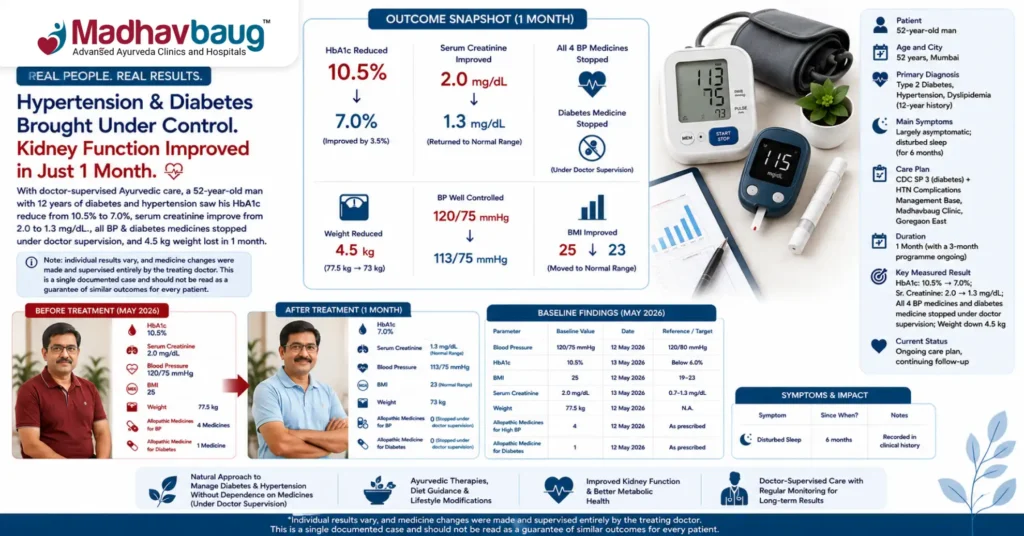
Opening Summary Mr Divanand Shetty, a 52-year-old hotelier from Mumbai, had been living with diabetes and hypertension for 10–12 years, dependent on four allopathic blood-pressure medicines and diabetes medication throughout. Years of a stressful, irregular routine with no fixed meal timings, no sleep schedule, had gradually taken a toll. His kidney function had started declining, with serum creatinine reaching 2.0 mg/dL. He came to Madhavbaug’s Goregaon East clinic wanting to bring his blood sugar and blood pressure under control naturally. He began a combination diabetes and hypertension care plan, and within just one month, all four of his anti-hypertensive medicines and his diabetes medicine were stopped under doctor supervision, his HbA1c dropped from 10.5% to 7.0%, and his serum creatinine improved from 2.0 to 1.3 mg/dL. He continues on his 3-month care plan with ongoing monitoring. Note: individual results vary, and medicine changes shown here were made and supervised entirely by the treating doctor. This is a single documented case and should not be read as a guarantee of similar outcomes for every patient. Outcome Snapshot Patient Mr Divanand Shetty Age and city 52 years, Mumbai Primary diagnosis Type 2 Diabetes, Hypertension, Dyslipidemia (12-year history) Main symptoms Largely asymptomatic; disturbed sleep for 6 months Care plan CDC SP 3 (diabetes) + HTN Complications Management Base, at Madhavbaug Clinic, Goregaon East Duration 1 month (with a 3-month programme ongoing) Key measured result HbA1c: 10.5% → 7.0%; all 4 anti-hypertensive medicines and diabetes medicine stopped under doctor supervision; weight down 4.5 kg; serum creatinine improved from 2.0 to 1.3 mg/dL Current status Ongoing care plan, continuing follow-up The Patient’s Story Mr. Shetty has run a hotel business for years, and the lifestyle that came with it, no fixed meal timings, no consistent sleep schedule, constant work-related stress that caught up with him. He was diagnosed with diabetes, hypertension and dyslipidemia, and stayed on allopathic medication for over a decade. Over time, his uncontrolled blood sugar began affecting his kidneys, with serum creatinine climbing to 2.0 mg/dL. He also had a strong family history of high blood pressure and stroke and was determined not to end up in that situation himself. Symptoms and Impact on Daily Life Symptom Since when? Notes Disturbed sleep 6 months Recorded in clinical history Medical History and Care Before Madhavbaug Known case of diabetes mellitus, hypertension, and dyslipidemia for approximately 12 years, on allopathic treatment throughout this period. He was taking 4 medicines for high BP and 1 medicine for diabetes at the time of starting care at Madhavbaug. Why the Patient Chose Madhavbaug After more than a decade on allopathic medication for his blood pressure and blood sugar, Mr. Shetty wanted to bring both under control naturally rather than remain dependent on daily medication. His declining kidney function reflected in an abnormal serum creatinine reading added urgency to this decision. He came to Madhavbaug’s Goregaon East clinic specifically seeking a natural approach to managing his diabetes and hypertension. Baseline Diagnostic Findings (May 2026) Parameter Baseline value Date Reference / target Blood Pressure 120/75 mmHg 12 May 2026 120/80 mmHg HbA1c 10.5% 13 May 2026 Below 6.0% BMI 25 12 May 2026 19–23 Serum Creatinine 2.0 mg/dL 13 May 2026 0.7–1.3 mg/dL Weight 77.5 kg 12 May 2026 N.A. Allopathic medicines for High BP 4 12 May 2026 Doctor’s Assessment and Goals As recorded by the treating team: with a 12-year history of diabetes and high blood pressure, Mr. Shetty’s metabolic health had been gradually declining, and his high blood sugar had begun affecting his kidneys, reflected in rising serum creatinine. Despite consistent allopathic medication, his blood sugar remained poorly controlled. The primary treatment goals were to bring his high blood sugar and high blood pressure under control. Personalised Care Plan Care component Details Diagnosis and follow-up Goregaon East Clinic: daily medicines, vitals tracked at every visit plus home BP and random blood sugar monitoring twice weekly Panchakarma / therapy CDC Panchakarma and HTN Complications Management, twice weekly, for detoxification therapy Diet plan Prameha Diet Kit, followed for 3 months, aimed at blood sugar and blood pressure reduction Activity / rehabilitation Daily combination exercises (~25 minutes, via a mobile app) to support blood sugar control Medicine coordination Allopathic medicines tapered under doctor supervision Care-Plan Narrative Mr Shetty’s treatment programme combined a diet kit, Panchakarma procedures, Ayurvedic medicines and a structured exercise programme. The diet kit was designed to be easy to prepare and portable; he could carry his meals to work in a tiffin, which made it practical to sustain alongside a demanding hotel business. Panchakarma sessions were scheduled twice weekly, one on a weekend and one midweek, alongside Ayurvedic medicines. His exercise programme was delivered through a mobile app and followed daily at home for about 25 minutes. He followed this combination for one month, within which his results changed substantially. His full programme is planned for 3 months; he is continuing the remaining course of treatment at the clinic. Given his strong family history of high blood pressure and stroke and the stress of running his own business, his commitment to the plan reflected a clear determination not to let his condition progress further. Progress and Measured Results Before-and-After Results Parameter Before After Change HbA1c 10.5% 7.0% ↓ 3.5 percentage points Serum Creatinine 2.0 mg/dL 1.3 mg/dL ↓ 0.7 mg/dL Returned to within normal range (0.7–1.3 mg/dL) Blood Pressure 120/75 mmHg 113/75 mmHg Modest further reduction, remained well-controlled BMI 25 23 ↓ 2 points Moved to within normal range Weight 77.5 kg 73 kg ↓ 4.5 kg Allopathic medicines for High BP 4 0 All 4 anti-hypertensive medicines were stopped under doctor supervision. Allopathic medicines for Diabetes 1 0 Diabetes medicine stopped under doctor supervision Results Narrative The most notable outcome in this case is that improved blood sugar and blood pressure control supported a meaningful recovery in kidney function, serum creatinine came down from 2.0 mg/dL to 1.3 mg/dL, back within the normal range, without any additional intervention beyond the structured diabetes and hypertension care plan. Alongside
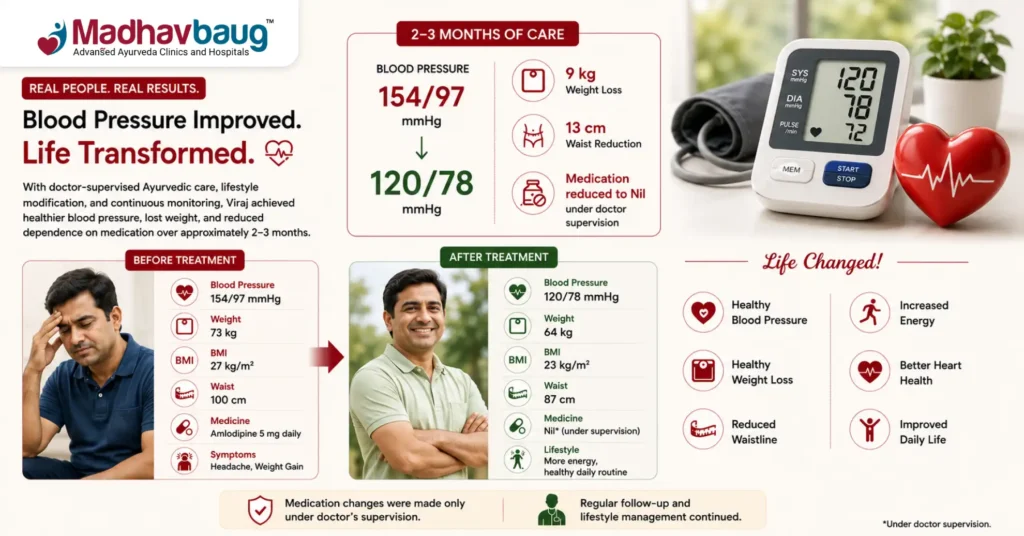
A real, doctor-supervised recovery, documented with before-and-after clinical results. Quick Summary Viraj Pandit consulted Madhavbaug Goregaon East Clinic for hypertension, weight gain, and recurrent headache. At baseline, clinic blood pressure was 154/97 mmHg, weight was 73 kg, and abdominal girth was 100 cm. A personalised programme combining regular medical follow-up, doctor-prescribed SHS Panchakarma, dietary modification, herbal medicines, exercise, yoga, and continuous monitoring was initiated. In the clinic comparison recorded after treatment, blood pressure improved to 120/78 mmHg, weight reduced to 64 kg, and abdominal girth reduced to 87 cm. Follow-up ambulatory blood pressure monitoring also showed improvement. Amlodipine was subsequently recorded as nil under medical supervision, with continued lifestyle follow-up. Parameter Before After Clinic Blood Pressure 154/97 mmHg 120/78 mmHg Weight 73 kg 64 kg BMI 27 kg/m² 23 kg/m² Abdominal Girth 100 cm 87 cm LDL Cholesterol 138 mg/dL 101 mg/dL Antihypertensive Medicine Amlodipine 5 mg daily Nil (under supervision) Patient at a Glance Field Details Patient Viraj Pandit Location Mumbai Primary Diagnosis Hypertension Main Symptoms Weight gain and headache Clinic Madhavbaug Goregaon East Treating Doctors Dr. Anuja Dalvi and Dr. Saloni Salvi Clinical Guide Dr. Bipin Gond, Zonal Medical Head Duration Approximately 2–3 months Key Result Blood pressure improved from 154/97 to 120/78 mmHg Current Status Blood pressure remained controlled at follow-up; medication recorded as ‘nil’ under doctor supervision The Patient’s Story Viraj Pandit was living with hypertension and taking amlodipine 5 mg once daily when she approached Madhavbaug Goregaon East Clinic. Her main concerns were weight gain and headache. Excess body weight and a 100 cm abdominal girth were important modifiable risk factors, while her elevated clinic blood pressure reading indicated that closer monitoring was required. She wished to improve blood pressure control through a structured lifestyle programme and hoped, where clinically safe, to reduce dependence on allopathic medication under medical supervision. The treatment team focused on measurable goals: safer blood pressure readings, weight and waist reduction, improved cardiovascular risk markers, better energy, and sustainable daily habits. Symptoms and Their Impact on Daily Life Symptom Severity / Frequency Impact on Daily Life Weight gain Clinically relevant: baseline weight 73 kg, BMI 27 kg/m² Contributed to increased cardiovascular risk and reduced sense of fitness Headache Frequency not stated Caused discomfort and was a concern given her high BP Reduced energy Reported before improvement The patient later reported greater energy for daily chores. Why She Chose Madhavbaug Viraj wanted better blood pressure control through lifestyle modification and wished to explore whether medication dependence could be reduced safely. She chose Madhavbaug for its integrated programme combining medical monitoring, diet, Panchakarma, exercise, yoga, herbal support, and supervised medicine coordination. Medical History Before Treatment At entry, Viraj had known hypertension and was on tablet amlodipine 5 mg once daily. Clinic blood pressure was 154/97 mmHg, baseline weight was 73 kg, BMI was 27 kg/m², and abdominal girth was 100 cm. Despite medication, she remained concerned about blood pressure control, weight gain, and headache and was seeking a structured, supervised programme. Medicine changes were never self-directed; her medication was stopped only after clinical improvement and doctor review. Baseline Diagnostic Findings Parameter Baseline Value Date Clinic Blood Pressure 154/97 mmHg Baseline Weight 73 kg Baseline BMI 27 kg/m² Baseline Abdominal Girth 100 cm Baseline ABPM Day Average 140/80 mmHg 22 July 2025 ABPM All-Time Average 137/79 mmHg 22 July 2025 LDL Cholesterol 138 mg/dL Day 1 Clinical Assessment and Treatment Goals Viraj presented with hypertension, an elevated clinic BP of 154/97 mmHg, excess weight, a BMI in the overweight range, and central adiposity, with headache as her main symptom. Ambulatory blood pressure monitoring (ABPM) was used because it assesses blood pressure across daytime, night-time, and the full 24-hour period, rather than relying on a single clinic reading. The treatment priorities were to achieve safer and more stable blood pressure readings, reduce weight and abdominal girth, improve cardiovascular risk markers, increase daily energy, and build sustainable lifestyle habits. A further goal was to review the need for amlodipine only after objective improvement was confirmed. Continued monitoring remained essential, since normal readings after treatment don’t mean hypertension can no longer recur, particularly if weight, diet, activity, sleep, or stress patterns deteriorate. Personalised Care Plan Care Component What Was Prescribed Purpose Diagnosis & Follow-Up Clinic reviews with BP, weight, BMI, abdominal girth, and ABPM assessment Track response and guide safe treatment decisions Panchakarma / Therapy Doctor-prescribed SHS Panchakarma Support the integrated hypertension-management programme Diet Plan Structured Madhavbaug diet plan with lifestyle modification Support calorie control, weight reduction, and BP management Activity / Rehabilitation Exercise and yoga Improve fitness, energy, stress management, and long-term adherence Medicine Coordination Amlodipine 5 mg reviewed, later recorded as nil Avoid unsupervised withdrawal and monitor BP stability The care plan was built around Viraj’s two major modifiable concerns: uncontrolled blood pressure and excess body weight. Regular clinic measurements and ABPM provided objective evidence of how her blood pressure behaved throughout the day and night. Dietary modification supported calorie control, reduced central adiposity, and improved overall cardiovascular risk, while exercise and yoga improved activity levels, stress regulation, and long-term adherence. Doctor-prescribed SHS Panchakarma and herbal medicines formed part of the integrated programme. Importantly, amlodipine was not stopped at the patient’s discretion. The medicine need was reviewed by the treating doctors alongside symptoms, clinic BP, and ambulatory readings. As objective parameters improved, the case record documented no allopathic antihypertensive medicine at follow-up. Ongoing lifestyle adherence and periodic monitoring remain necessary, since hypertension can return even after a period of good control. Recovery Timeline Time Point Objective Measure Doctor Action Baseline BP 154/97 mmHg; weight 73 kg; waist 100 cm Set BP, weight, and monitoring goals Month 1 Diet, SHS Panchakarma, exercise/yoga, and monitoring continued Reviewed progress clinically Day 60 BP 120/78 mmHg; weight 64 kg; waist 87 cm Medication status reviewed Day 90 Total cholesterol 183; TG 87; HDL 65; LDL 101 mg/dL Cardiovascular risk markers reassessed Latest Follow-Up (2 Nov 2025) ABPM: day 131/79, night 117/69, all 129/78 mmHg Continued monitoring, lifestyle
Patient Profile Bhakti Sukhthankar, a 33-year-old IT professional from Mumbai, had been living with hypertension for nearly three years. Despite taking two anti-hypertensive medicines regularly, her blood pressure remained uncontrolled. Along with high blood pressure, she experienced occasional headaches, increasing weight, and persistent fatigue by the end of her workday. Her demanding job, irregular eating habits, and lack of proper sleep further affected her overall health and quality of life. Like many young working professionals, Bhakti wanted to regain control over her health instead of depending entirely on medicines. Looking for a holistic approach that addressed the root causes of her condition, she visited Madhavbaug’s Goregaon East clinic along with her sister, who was also seeking help for weight management. Initial Assessment During her first consultation, Bhakti underwent a detailed evaluation of her health, lifestyle, and medical history. At the time of her first visit, her blood pressure was 154/97 mmHg, indicating uncontrolled hypertension despite medication. She weighed 80 kg, and ambulatory blood pressure monitoring (ABPM) showed an average blood pressure of 142/93 mmHg, which corresponded to Stage 2 Hypertension. She was taking two anti-hypertensive medicines daily. A detailed discussion with the treating doctors revealed that her hectic work schedule, irregular meal timings, inadequate sleep, and unhealthy lifestyle habits were major contributors to her condition. Although she had attempted dieting and exercise in the past, she found it difficult to lose weight or maintain consistency due to her demanding routine. The medical team also advised additional blood investigations and ABPM to understand her cardiovascular risk profile and to create a personalised treatment plan. Personalised Treatment Plan Based on her assessment, Bhakti was enrolled in a three-month Hypertension Complications Management Programme at Madhavbaug. Her treatment plan was individualised to suit her lifestyle while focusing on improving blood pressure control, reducing excess weight, and enhancing her overall wellbeing. The programme included: Personalised Ayurvedic medicines prescribed under medical supervision. Weekly Panchakarma-based therapies aimed at supporting metabolic balance and overall health. A structured dietary programme using the Gobipi Diet Kit, which was easy to prepare and convenient for carrying to work. A daily exercise routine of approximately 25 minutes through the Madhavbaug mobile application. Regular monitoring of blood pressure and vital signs during clinic visits, along with home blood pressure monitoring twice every week. Careful supervision while gradually reducing conventional anti-hypertensive medicines based on her clinical progress. The treatment plan was designed to fit into her busy schedule. Since Panchakarma sessions were scheduled on weekends and the diet plan required minimal preparation, she found it practical to follow consistently. Journey Towards Better Health Bhakti remained committed to every aspect of her treatment programme. She followed the prescribed diet, attended therapy sessions regularly, took her medicines as advised, and performed her daily exercise routine without interruption. Within the first month, significant improvements were observed. Her blood pressure reduced to 125/73 mmHg, and she lost 5 kg. Most importantly, her headaches had completely resolved. Based on her steady improvement, one of her anti-hypertensive medicines was tapered under medical supervision. By the second month, her blood pressure remained stable at 127/88 mmHg, and she had achieved a total weight loss of 8 kg. Since her readings remained consistently controlled, all anti-hypertensive medicines were gradually discontinued under the supervision of her treating doctors. At the end of three months, Bhakti’s blood pressure had further improved to 114/77 mmHg, and she had successfully lost 11 kg. Her repeat ABPM demonstrated a remarkable improvement, showing normalisation of blood pressure patterns compared to the Stage 2 hypertension observed at the beginning of treatment. Her pulse rate reduced from 86 beats per minute to 65 beats per minute, while her abdominal girth reduced from 96 cm to 85 cm, reflecting improvements in overall metabolic health. During her latest follow-up, her blood pressure continued to remain well-controlled at 110/75 mmHg, and she reported no recurrence of headaches or other symptoms. Improvements Beyond the Numbers Although the clinical improvements were significant, Bhakti believes the biggest change was in the way she felt every day. Before starting treatment, she often experienced exhaustion after work and lacked the energy to exercise or participate in activities she enjoyed. Her persistent headaches and concern about uncontrolled blood pressure also affected her confidence. Following the programme, she reported feeling much more energetic throughout the day. She now exercises for nearly one hour every day, including more intense workouts that she could not perform earlier. She sleeps better, feels physically stronger, and is able to manage her work responsibilities more comfortably. Weight loss also helped improve her self-confidence. She happily shared that she can now wear clothes she had stopped using because of weight gain and feels healthier both physically and emotionally. Patient Experience Reflecting on her journey, Bhakti expressed immense satisfaction with the overall outcome. She shared that one of the biggest changes in her life has been becoming free from dependence on anti-hypertensive medicines under her doctor’s supervision while maintaining controlled blood pressure. Along with improved health, she appreciates the confidence she has gained through sustained weight loss and healthier lifestyle habits. She credits the structured programme, regular medical guidance, and practical dietary recommendations for helping her remain consistent throughout her treatment. Doctor’s Perspective According to the treating medical team, Bhakti’s case highlights the importance of addressing lifestyle factors alongside medical management in patients with hypertension. Her long working hours, inadequate sleep, unhealthy eating habits, and weight gain were significant contributors to her uncontrolled blood pressure. Through a personalized programme consisting of Ayurvedic treatment, diet modification, regular exercise, Panchakarma therapies, and continuous monitoring, she demonstrated consistent improvement in both blood pressure and metabolic health. The doctors emphasise that every patient’s condition is unique, and treatment plans should always be individualised. While Bhakti achieved excellent results, similar outcomes cannot be guaranteed for every patient. Regular monitoring, adherence to medical advice, and long-term lifestyle modification remain essential for maintaining cardiovascular health. Conclusion Bhakti’s journey demonstrates how a comprehensive and personalised approach can help improve blood pressure control and overall

