
Coronary Artery Disease in Women: Symptoms, Risk Factors and Prevention
Quick answer Chest discomfort remains the most common heart-attack symptom in women, but women are more likely to experience additional


When patients come to me and say,
“Doctor, I have sugar… but which type is it?”
It tells me one thing clearly — diabetes is still widely misunderstood.
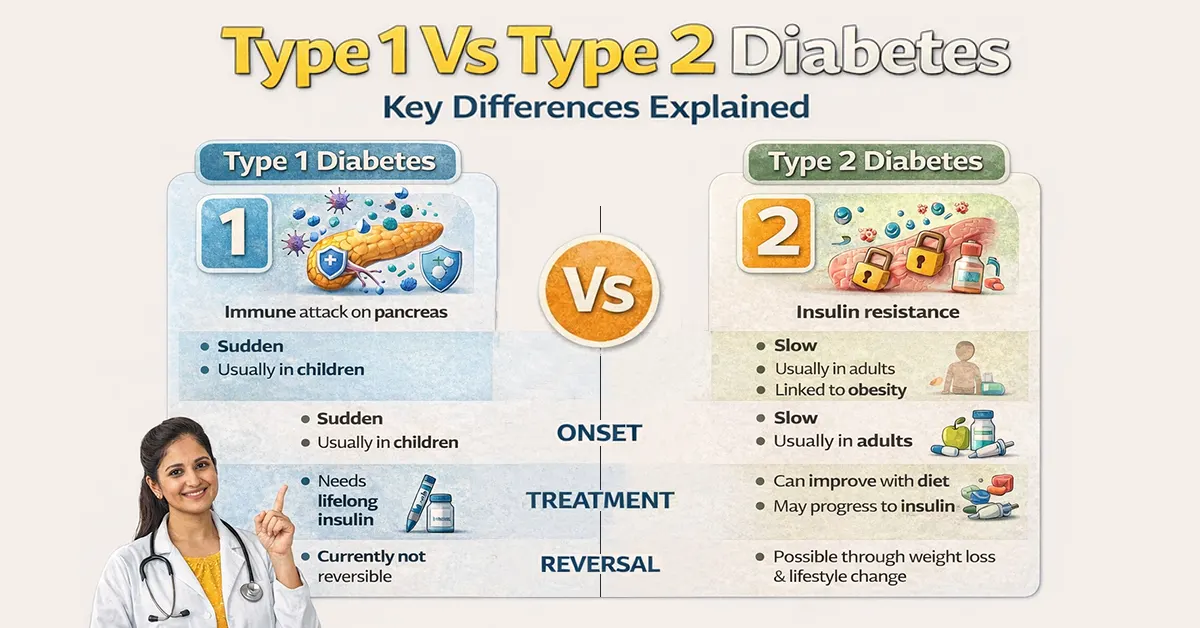
Many people think diabetes is just “high sugar”. But when we discuss type 1 vs type 2 diabetes, we are actually talking about two very different conditions that only share one thing in common – elevated blood glucose levels.
Let’s break this down in a simple, clear, and practical way.
Diabetes is a chronic condition caused by hyperglycaemia — raised blood sugar. This happens when:
Insulin is the hormone that allows glucose to enter cells and be used as energy. Without proper insulin function, sugar accumulates in the bloodstream, damaging nerves, blood vessels, kidneys, eyes, and the heart over time.
While both types lead to high sugar levels, the biological “why” behind each condition is completely different.
Think of it this way:
Let’s understand how.
Type 1 Diabetes – An Immune System Mistake
Type 1 is an autoimmune disease.
The body’s immune system mistakenly attacks and destroys the insulin-producing beta cells in the pancreas. As a result:
Without insulin, the body literally goes into cellular starvation even though sugar levels are high.
Type 1 is usually diagnosed in children or young adults and was formerly called “juvenile diabetes”. It accounts for roughly 8–10% of all cases of diabetes.
Type 2 Diabetes – Insulin Resistance
In type 2 diabetes:
This is called insulin resistance.
Initially, the pancreas tries to compensate by producing more insulin. Over time, it becomes exhausted. Then two problems occur:
Type 2 accounts for nearly 90% of all diabetes cases in India and globally.
Type 1 – Sudden and Dramatic
It is not caused by lifestyle or diet.
Type 2 – Slow and Silent
Many patients are diagnosed during routine blood tests.
In India, increasing abdominal obesity and insulin resistance make Type 2 diabetes extremely common.
Because the causes differ, treatment strategies differ.
Type 1 Diabetes – Lifelong Insulin
People with Type 1 produce no insulin. Therefore:
Insulin is not a “last stage” treatment — it is essential for survival.
Type 2 Diabetes – Stepwise Management
Management begins with lifestyle correction:
In early stages, some patients can control sugar levels with these measures alone.
Drugs like Metformin and other oral agents improve insulin sensitivity and reduce glucose production.
Injectables such as GLP-1 agonists may be added when required.
If the pancreas becomes significantly exhausted, insulin may eventually be needed.
This is where structured type 2 diabetes treatment becomes essential — not just controlling numbers, but correcting insulin resistance at its root.
This is one of the most common questions.
| Feature | Type 1 | Type 2 |
| Cause | Autoimmune | Insulin resistance |
| Prevention | Currently not possible | Highly preventable |
| Reversal | Not reversible | Can go into remission |
Type 2 diabetes, especially in early stages, can often be reversed or put into remission with the following:
In integrative care models, Ayurvedic treatment for diabetes focuses on improving digestion (Agni), correcting metabolism, reducing inflammation, and enhancing insulin sensitivity under medical guidance.
Both types can cause similar complications if unmanaged:
High sugar levels damage blood vessels like “slow internal injury”.
Type 1 – Risk of DKA
Diabetic ketoacidosis (DKA) is life-threatening and requires emergency treatment.
Type 2 – Risk of HHS
Hyperosmolar Hyperglycaemic State (HHS) causes extremely high sugar and severe dehydration.
Both are medical emergencies.
Final Takeaway: Type 1 Vs Type 2 Diabetes in One Line
Type 1 = The pancreas cannot produce insulin.
Type 2 = The body cannot use insulin properly.
One is a factory shutdown.
The other is a distribution failure.
Understanding this difference helps patients make informed decisions rather than living in confusion or fear.
A Doctor’s Advice
If you are:
Do not wait for complications.
Early evaluation, proper diagnosis, and structured management can protect your heart, kidneys, nerves, and quality of life.
Diabetes management is not about panic.
It is about clarity, correction, and consistency.


Quick answer Chest discomfort remains the most common heart-attack symptom in women, but women are more likely to experience additional

Have you ever been through this situation wherein you had chest pain, you visited your doctor and they suggested an