
Coronary Artery Disease in Women: Symptoms, Risk Factors and Prevention
Quick answer Chest discomfort remains the most common heart-attack symptom in women, but women are more likely to experience additional


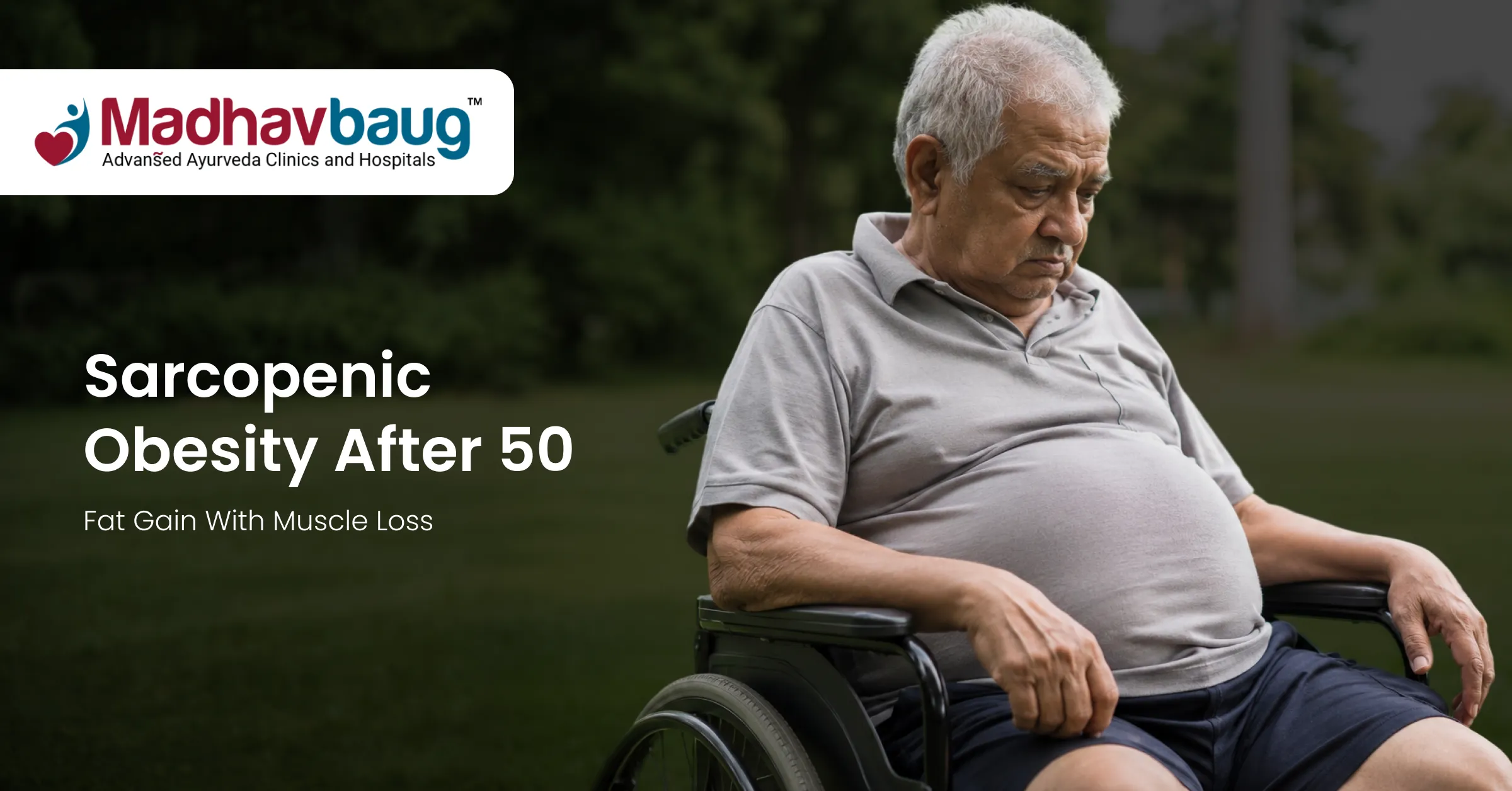
Most people above 50 with a normal body weight simply assume they are healthy. But the scale does not show whether the weight is made up of fat or muscle.
For many people in this age group, changes are happening gradually. Fat builds up while muscle decreases, even when total body weight remains the same.
That combination is sarcopenic obesity, and it can lead to serious health issues if it is not addressed in time.
At Madhavbaug, weight is just the starting point. What matters more is how the body is actually functioning, and that is what the treatment is built around.
Sarcopenic obesity is a condition where fat gain and muscle loss exist together in older adults, and is found in almost 14% of older people(Luo et al. 2024).
The person affected may not look unhealthy or overweight, and the condition often goes unnoticed.
Fat in such people is stored around internal organs and in between muscle fibres, while the muscles themselves are getting weaker and smaller. This is why standard weight checks miss it so often.
Excess fat can cause inflammation in the body, decrease muscle mass, and lead to an ongoing cycle.
The scale just shows total body weight. It cannot tell you how much of that weight is fat and how much is muscle.
Two people can weigh exactly the same and have very different bodies. One can have a healthy mix of body fat and muscle mass, while the other may have less muscle mass and a higher fat percentage, which can be the case of sarcopenic obesity.
This is why BMI, which is also based on weight and height alone, can completely miss the condition. A person with sarcopenic obesity may fall in either the normal or the overweight BMI range while quietly losing muscle and gaining fat around their internal organs.
Waist size gives a better picture of belly fat than weight alone, and measuring your waist-to-height ratio is one of the simplest ways to check this at home. But the most reliable way to assess this condition is through a clinical evaluation that looks at muscle mass, fat percentage, strength, and physical function together.
Sarcopenic obesity does not develop overnight. Several factors make some people more at risk than others, and many of these are directly linked to the way the body changes after 50.
Age-related changes
At around 30 years, the body begins to change, and the muscle mass starts to reduce naturally. At the age of 50, this process speeds up.
At the same time, the metabolism slows down, which makes it easier for fat to build up even if there is no major change in diet or activity.
Hormonal shifts
In women, the drop in oestrogen (female hormone) after menopause is closely related to increased fat storage, particularly around the belly. In men, declining testosterone (male hormone) levels contribute to muscle loss. Both changes create the conditions that lead to sarcopenic obesity.
Sedentary lifestyle
Sitting for long hours, walking less, and avoiding any form of physical activity all speed up muscle loss. Research confirms that sedentary behaviour is directly linked to sarcopenia in older adults (Ji et al., 2022).
Poor protein intake
As people get older, their appetite often decreases. They usually prefer lighter meals, and those often lack any protein. Without enough protein intake, the body struggles to maintain muscle.
Chronic conditions
Type 2 diabetes, high blood pressure, and heart disease all increase the probability of sarcopenic obesity. Insulin resistance, where the body stops responding to insulin as it should, also speeds up the process.
People already dealing with diabetes, high blood pressure, or heart disease face a higher chance of developing this condition and should get screened early.
Sarcopenic obesity does not always show clear signs. There is no single obvious symptom that makes you think something is wrong. There are only small, easy-to-miss clues in everyday movement.
These are two simple checks that can give a useful early indication at home, without any equipment.
Sit in a straight-backed chair with your arms crossed over your chest. Try to stand up and sit back down five times as quickly as you can, without using your arms for support.
If this feels difficult or you need your arms for support, your leg muscles may not be as strong as they should be, and it is worth talking to a doctor.
Most people do not realise how much a simple grip strength test can reveal. Try squeezing a firm object like a rolled towel as hard as you can. If this feels weaker than it used to, or if everyday tasks like opening jars or lifting bags have become harder, that is a sign worth taking seriously.
Other everyday signs to watch for:
No single sign here points to a definite diagnosis. If you are above 50 and your weight appears in a normal range, it is still worth getting a proper body composition assessment done, especially if you have noticed a decline in strength or energy.
Muscle loss after 50 does not have to be permanent. The right combination of exercise and nutrition can surely slow it down, preserve what is there, and in many cases can also help rebuild it.
Strength Exercises
Strength exercises, also called resistance training, involve movements where your muscles work against a force, like your own body weight, a resistance band, or light weights. This type of exercise is the most effective way to address sarcopenic obesity.
Research shows that doing strength exercise around two to three times a week for a duration of 20 to 60 minutes can help reduce body fat, increase muscle mass, and improve strength, which can further help people move faster and improve stability. When combined with higher protein intake, it reduces fat percentage even more (Eglseer et al., 2023).
Traditional forms in Ayurveda, like Danda ( push-up movement) and Baithak (a deep squat), have been practised for generations to build strength and stamina. Other variations, like Hanuman Dand, that help move the whole body in one connected motion, and Surya Namaskar, can help you build a routine that keeps muscles engaged without any equipment.
For someone over 50, this is a good place to start:
Ayurveda’s own guideline is to exercise only up to half of one’s natural strength, or Ardhashakti, stopping once breathing quickens or a light sweat appears, rather than pushing to exhaustion.
Protein Intake
Rather than counting protein in grams, Ayurveda considers the guna, or quality, of food. After 50, digestion becomes naturally slower, so the goal is to consume food that is laghu (light, easy to digest) and snigdha (nourishing) at the same time. This combination builds the muscle tissue and does not leave any undigested residue, which can turn into fat.
Everyday foods that fit this profile include:
Eating smaller portions and maintaining a proper gap between meals throughout the day is the recommended way of living.
Staying Active Through the Day
Work on avoiding sitting in one place for a longer duration. Short walks after meals, taking the stairs, and avoiding long stretches of sitting without a break all support better muscle and metabolic health over time.
The medical benefits of managing weight in older adults are not only about maintaining how you look, but maintaining muscle mass also reduces the risk of falls, fractures, diabetes, and heart disease.
Ayurveda relates changes that come with aging to Vata dosha (the body’s energy that controls movement and dryness), which increases with age and can be the cause of muscle loss.
Agni (the digestive fire) also slows down, and undigested material builds up in the body that gets stored as fat, particularly around the organs.
Madhavbaug’s Ayurvedic approach to weight loss and obesity works on both Vata dosha and Agni together.
Panchakarma: It is a detoxification protocol that clears metabolic waste from the body, improves digestion, and supports overall health.
Customised herbal formulations: These are special compositions that support digestion and metabolic regulation. Medicines used in Madhavbaug’s obesity programme include Mednox Tablet, Golekh Capsule, and Nano Tone Capsule.
Diet and Monitoring: The Swasthyam Diet Kit is a customised meal plan for 28 days that is built around every patient’s specific metabolic needs.
All the results from the progress are recorded in the mibPULSE app, which helps the doctors to keep a track and adjust the programme as needed.
For those managing diabetes alongside sarcopenic obesity, insulin resistance, which affects both muscle breakdown and fat deposition, is also addressed as part of the protocol.
Catching sarcopenic obesity early makes a big difference. The simple checks can be done at home as described above, and can give you an early hint, but only a proper assessment can confirm what is actually happening in the body.
Obesity in older adults is often assessed using weight and BMI alone, which completely misses the muscle loss component.
Doctors typically follow a two-step process to confirm sarcopenic obesity. Muscle function is checked first. If there is a concern, body composition is then measured to confirm it (Donini et al., 2022).
Two tests are commonly used in this process:
At Madhavbaug, various factors like body composition, blood pressure, heart risk markers, metabolic health, and daily lifestyle habits are all assessed together. Only then is a treatment plan put in place. The Ayurvedic weight loss and obesity programme at Madhavbaug is built around this complete picture, not just a number on the scale.
Sarcopenic obesity is one of the most underdiagnosed conditions in adults over 50. The scale will not show it. BMI will often miss it. But the body gives clear signals, in grip strength, in how easily a person rises from a chair, in belly fat deposition despite a stable weight, if someone knows what to look for.
The good news is that it is not permanent and it is not irreversible. The right combination of strength exercise, adequate protein, Ayurvedic therapies, and medical supervision can slow the process, preserve muscle, and reduce fat in a way that produces lasting results.
At Madhavbaug, treatment begins with understanding the full picture. Book a consultation to get a proper assessment and a plan that works for your age, your body, and your health.
Is skinny fat sarcopenic obesity?
Not exactly, but they are closely related. Skinny fat describes someone with a normal or low body weight but high body fat and low muscle. Sarcopenic obesity is a more advanced and clinically defined version of this pattern, seen in older adults, where muscle loss is significant.
Can sarcopenic obesity be reversed?
Fully reversing it is difficult, but meaningful improvement is possible. Strength exercise, adequate protein, and supervised treatment can rebuild some muscle and reduce fat. Starting earlier gives better results.
Can you gain weight with sarcopenia?
Yes. Sarcopenia causes muscle loss, and since muscle is denser than fat, the scale may stay the same or even go up as fat replaces muscle. This is exactly why weight alone is a misleading measure in older adults.
How much protein do I need after 50?
A general guideline for adults over 50 is around 1.2 to 1.6 grams of protein per kilogram of body weight each day. Good everyday sources include dal, rajma, paneer, curd, eggs, and nuts. Spreading protein across all three meals works better than eating most of it in one go.
How does Ayurveda help with sarcopenic obesity?
Ayurveda addresses both the fat gain and the muscle weakness that come with ageing. At Madhavbaug, therapies like Snehan, Basti and Panchakarma work on fat metabolism and detoxification, while a personalised diet plan and herbal medicines support metabolic health. Progress is tracked through the mibPULSE app throughout the programme.\

Quick answer Chest discomfort remains the most common heart-attack symptom in women, but women are more likely to experience additional

Have you ever been through this situation wherein you had chest pain, you visited your doctor and they suggested an