
Coronary Artery Disease in Women: Symptoms, Risk Factors and Prevention
Quick answer Chest discomfort remains the most common heart-attack symptom in women, but women are more likely to experience additional


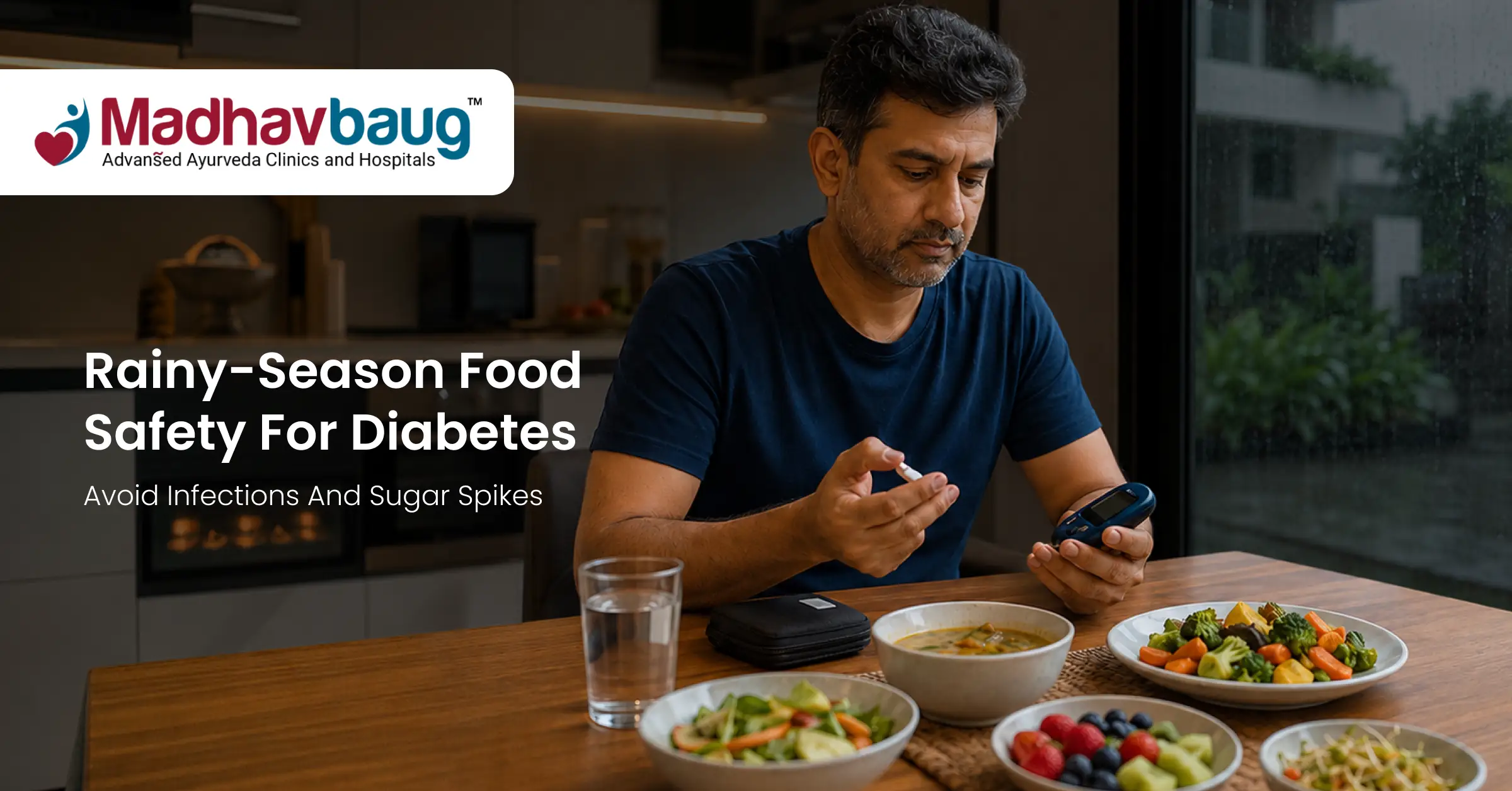
Today the water pollution and contamination levels are increasing. The humidity levels also tend to increase in monsoons. Keeping all factors in mind, food safety for diabetics is a major concern that we must address. During this season, we commonly see bacterial and waterborne diseases. People with diabetes and low immunity are more easily affected than others. Thus, extra care needs to be taken to avoid infection risk.
Madhavbaug, the centre that treats root causes rather than just symptoms, sets a benchmark for both diabetes management and diabetes reversal. Stepping towards holistic health, it focuses not only on the curative aspect but also on the preventive one.
An infection may affect a host for two main reasons. Firstly, the predominance of the infectious agent and, secondly, the weak immune system of the host. During the monsoon, both water and wind increase, leading to a drastic rise in infectious agents and a rapid surge in waterborne and airborne infections.
With these conditions, there is a severe increase in mosquitoes and parasites, causing a rise in infections. They affect humans, leading to dengue, malaria and many more infections.
Diabetic people have a higher risk of developing such infections due to the weakened immune system of the host.
Now the question arises: how can an infection disturb glucose levels?
Our body energy largely depends on glucose. Usually the immune cells in the body use up to 20% of the body’s energy. However, in a state of infection, the immune cells use 30% of the body’s energy. (Straub, R.H.; 2010)
In addition, research also suggests that the cells of the immune system and the cells of the endocrine system, which balance our hormones, including insulin, are largely connected and that immune cells respond to insulin, causing changes in systemic metabolism. (Sestan, M.; 2010)
This evidence shows that diabetic people are at greater risk during monsoons due to a higher risk of infection.
Food poisoning in the rainy season is common due to water contamination. So it becomes important for diabetic people to be careful and ensure proper food safety. To maintain food hygiene, the following high-risk foods should be avoided:
Diabetic patients can adapt many dietary habits. One of the popular ones includes the Mediterranean diet (Kastorini CM, 2010). It encourages daily consumption of fruits, vegetables, low-fat dairy products and whole grains; weekly consumption of fish, tree nuts and legumes; as well as high ingestion of dietary fibre, antioxidants and magnesium. The effects of implementing this diet include reduced oxidative stress and insulin resistance, which help prevent diabetes.
The preventive principles in Ayurveda mainly include ‘Ahar’ and ‘Vihar’, which mean ‘Food’ and ‘Regimen’.
The Ayurvedic concept of ‘Ritucharya’ – the seasonal regimen – includes a list of food that should be consumed and avoided. Following is the list for Varsha Ritucharya – the monsoon seasonal guide.
| Food to be consumed | Food to be avoided |
| Food having Amla rasa (sour) and Lavana rasa (salty) and sneha
(Unctuous) qualities should be eaten. Old barley, wheat and Shali rice (Oryza sativum Linn.) maintain digestive power. One should drink Madhvika Arishta (a honey-based fermented drink) It is advised to drink pure rainwater that has been boiled and cooled. |
Foods having Katu (spicy) and Kashaya rasa (astringent) and guru
(heavy to digest) qualities should be avoided. |
Madhavbaug has brought many innovations in treating diabetes through Ayurveda. Among these innovations are Prameha gummies and Madhavprash, designed to enhance immunity. Following are some techniques through which Madhavbaug focuses on addressing the root cause and not just stabilising the blood sugar levels.
Procedures like Virechana (purgation) include cleansing the gut and removing toxins. These procedures, along with Snedana (oil therapy), Svedana (heat therapy), and Basti (medicated enema), modify the GALT (Gut Associated Lymphatic Tissue) in the lamina propria of the GIT, which is also responsible for immunity. The therapy is also effective in managing the pathological disease. (Thanigainathan A., 2021)
Madhavbaug’s diet plan is the modern expression of Prameha Chikitsa Ahara (Diet for Diabetics) to mobilise Ama (toxins) and Meda (fat), restoring Agni (metabolic fire) and Jatharagni (digestive capacity).
With these interventions, progressively reducing the patient’s dependence on allopathic drugs is also important. So Madhavbaug has medications like Symsa (metabolic support) and organ-specific herbal combinations for glucose regulation and lipid management.
In addition, the MIB app brings an integrated approach to health, helping to monitor blood sugar levels constantly. Also, diet alone is not sufficient. Madhavbaug’s customised exercise plan can help you manage your diabetes more effectively. To start your journey towards holistic health, book a consultation at your nearest Madhavbaug centre.
Q.1 What are the safe food options for diabetics during monsoon season?
Old barley; millets such as ragi and jowar; and fruits such as dragon fruit, citrus fruits, etc.
Q.2 How to prevent food poisoning for diabetics during the wet season?
Maintain proper food and water hygiene and avoid unhealthy, processed and packaged food.
Q.3 Which food items are prohibited in diabetes?
Sugar-sweetened beverages, refined carbohydrates, ultra-processed items, and foods high in trans or saturated fats.
Q.4 How much rice can a diabetic eat?
Diabetics can generally eat 1/2 cup (about 90 grams) to 1 cup of cooked rice per meal, which contains roughly 15 to 45 grams of carbohydrates.
Q.5 What is the golden drink for diabetes?
To make golden milk, a person will need: 1/2 cup milk, typically nondairy milk such as coconut or almond milk. 1 tsp ground turmeric. 1 tablespoon (tbsp) grated fresh ginger or 1/2 tsp ginger powder.
Arneth, Borros. 2023. “Insulin Resistance and Glucose Metabolism during Infection” Endocrines 4, no. 4: 685-695. https://doi.org/10.3390/endocrines4040049
Tsoli, M.; Boutzios, G.; Kaltsas, G. Immune system effects on the endocrine system. In Endotext; MDText.com, Inc.: South Dartmouth, MA, USA, 2019.
Straub, R.H.; Cutolo, M.; Buttgereit, F.; Pongratz, G. Energy regulation and neuroendocrine-immune control in chronic inflammatory diseases. J. Intern. Med. 2010, 267, 543–560.
Sestan, M.; Marinovic, S.; Kavazovic, I.; Cekinovic, D.; Wueest, S.; Wensveen, T.; Brizic, I. Virus-induced interferon-gamma causes insulin resistance in skeletal muscle and derails glycaemic control in obesity. Immunity 2018, 49, 164–177.e166.
Kastorini CM, Panagiotakos DB. Mediterranean diet and diabetes prevention: Myth or fact? World J Diabetes. 2010;1(3):65–7. doi: 10.4239/wjd.v1.i3.65.
Rahati S, Shahraki M, Arjomand G, Shahraki T. Food pattern, lifestyle and diabetes mellitus. Int J High Risk Behav Addict. 2014 Mar 10;3(1):e8725. doi: 10.5812/ijhrba.8725. PMID: 24971303; PMCID: PMC4070192.
A, T., Selvalenin C, Lakshmi Kantham T, Vetha Merlin Kumari H, Nalini Sofia H, Mary Sharmila C, Anbarasan B and Meenakumari R (2024) “VIRESANAM – PURGATION THERAPY IN SIDDHA”, Journal of Siddha. India, 5(1), pp. 52-60.

Quick answer Chest discomfort remains the most common heart-attack symptom in women, but women are more likely to experience additional

Have you ever been through this situation wherein you had chest pain, you visited your doctor and they suggested an