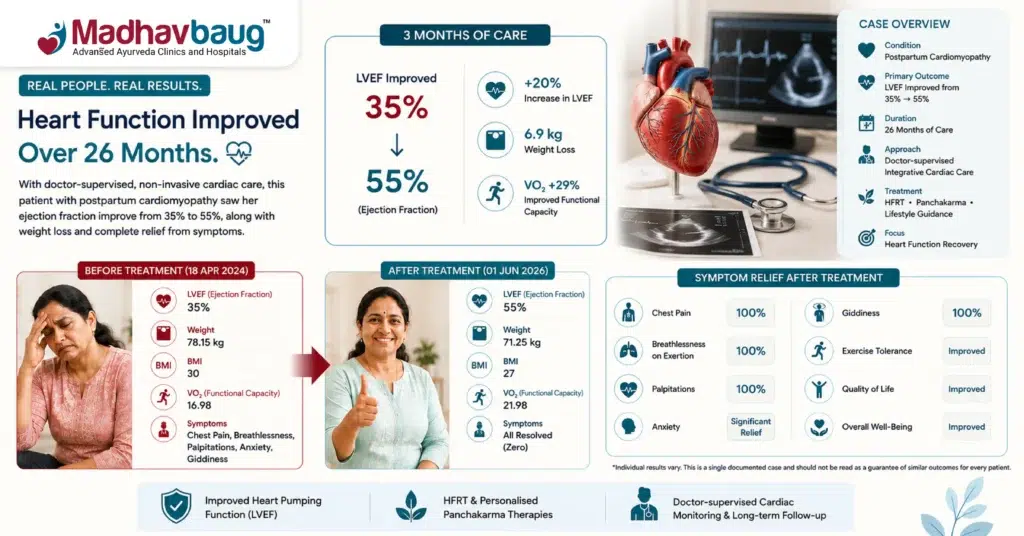
Opening Summary Sunita Yemul, a 41-year-old woman, was diagnosed with postpartum cardiomyopathy, a severely reduced ejection fraction of 35%, global hypokinesia of the left ventricle and a dilated left atrium alongside chest pain, breathlessness on exertion, palpitations, anxiety and giddiness that had continued for nearly two years. She began a doctor-supervised, non-invasive cardiac care plan at Madhavbaug, coordinated with her treating cardiologists. Over more than two years of monitored care, her ejection fraction improved from 35% to 55%, her weight reduced from 78.15 kg to 71.25 kg, and her presenting complaints resolved completely. She continues under periodic cardiac follow-up. Note: individual results vary. This is a single documented case and should not be read as a guarantee of similar outcomes for every patient. Outcome Patient Sunita Yemul Age and city 41 years at baseline (18 Apr 2024) | Solapur Primary diagnosis Postpartum cardiomyopathy, concentric LVH, dilated left atrium, global LV hypokinesia, LVEF 35% (confirmed on 2D Echo, 18 Apr 2024) Main symptoms Chest pain, breathlessness on exertion (Grade I), palpitations, anxiety, giddiness Care plan Madhavbaug non-invasive cardiac care programme with periodic clinical and diagnostic monitoring, coordinated with treating cardiologists’ medicine management Duration Approximately 26 months (18 Apr 2024 baseline to 01 Jun 2026 latest follow-up) Key measured result LVEF: 35% (18 Apr 2024) → 55% (01 Jun 2026) Current status Adequate LV function on the latest echo, complaints resolved (“Zero”), continuing periodic follow-up The Patient’s Story Sunita Yemul, 41, conceived through IVF and became a mother. Soon after delivery, she was diagnosed with postpartum cardiomyopathy leading to heart failure. Alongside the physical symptoms, the diagnosis affected her emotionally: coming so soon after the IVF journey, it shook her confidence, and she gradually developed anxiety. She carried this combination of physical limitation and emotional strain for close to two years before starting her care plan at Madhavbaug. Symptoms and Impact on Daily Life Symptom / limitation Since when? Severity / frequency Daily-life impact Chest pain ~2 years (from diagnosis) Moderate Hampered daily routine; quality of life decreased Breathlessness on exertion (DOE) ~2 years Grade I Hampered daily routine; quality of life decreased Palpitations ~2 years Severe Hampered daily routine; quality of life decreased Anxiety and giddiness ~2 years Severe Hampered daily routine; quality of life decreased Medical History and Care Before Madhavbaug Confirmed diagnosis of postpartum cardiomyopathy, made approximately 2 years before the Madhavbaug baseline record, reconfirmed on 2D Echo dated 18 Apr 2024 (concentric LVH, dilated LA, global hypokinesia of LV, LVEF 35%, trivial MR) at Apex Superspeciality Hospital & Research Centre, Solapur, under Dr Rizwan ul Haque. Medicines at entry: Sacutan 50 mg BD, Dapazol 10 mg OD, Dompsn SR OD, Nebicip 2.5 mg HS, Aldactone 25 mg OD. Why the Patient Chose Madhavbaug Given the severity of her diagnosis, Sunita wanted a structured, closely monitored programme rather than medicine management alone. She came to Madhavbaug looking for hope, drawn by its cardiac care programme built over nearly two decades of work in cardiac disease reversal and the encouraging results reported by other patients with similar heart conditions. From her first consultation, she found the doctor patient in listening to her concerns and consistent in monitoring her condition, which gave her the confidence that recovery was possible. Baseline Diagnostic Findings Parameter / test Baseline value Reference / target LVEF (2D Echo) 35%, global hypokinesia Normal ≥ 55% BMI 30 18.5–22.9 (Asian) Weight 78.15 kg N.A. HbA1c 5.5% <5.7% (non-diabetic) Within normal range Blood Pressure 122/78 mmHg <120/80 mmHg Heart Rate 90 bpm 60–100 bpm Within normal range VO2 (functional capacity) 16.98 N.A. NT-proBNP 274 pg/mL Age/sex-specific cut-off GLS 13.5 (05 Aug 2024) N.A. Serum Creatinine 0.9 mg/dL 0.6–1.1 mg/dL Within normal range Personalised Care Plan Care component What was prescribed Frequency / duration Purpose / monitoring Diagnosis and follow-up Periodic clinical review with 2D Echo reassessment Echo repeated at ~4 months and again at ~26 months Tracked LVEF, chamber size and valve function over time Panchakarma / therapy HFRT 3 Panchakarma therapy Twice weekly To increase cardiac functional capacity Diet plan Madhashakti atta with a customised diet chart Daily Supported the weight reduction from 78.15 kg to 71.25 kg Activity / rehabilitation MIB Pulse app-guided exercise Daily Supported the rise in VO2 from 16.98 to 21.98 Medicine coordination Coordinated with the treating cardiologist; medicines adjusted over follow-up As advised by the treating doctor Doctor-supervised titration alongside clinical improvement Care-Plan Narrative Sunita’s care plan combined HFRT 3 Panchakarma therapy, given twice a week to increase her cardiac functional capacity, with a customised diet built around Madhashakti atta and a personalised diet chart. She also followed daily MIB Pulse app-guided exercise as part of her activity plan. Alongside this, her allopathic cardiac medicines continued to be managed and adjusted by her treating cardiologist as her clinical picture changed. Periodic clinical review and repeat 2D Echo assessment were used to track how her heart function was responding over time. Together, this combination supported the rise in her functional capacity (VO2) from 16.98 to 21.98, her weight loss from 78.15 kg to 71.25 kg, and the improvement in her ejection fraction from a severely reduced 35% toward the normal range. Progress and Measured Results Recovery Timeline Time point Symptoms / function Objective measure Treatment / adherence Doctor action Baseline 18 Apr 2024 Chest pain, DOE, palpitations, anxiety, giddiness LVEF 35%, global hypokinesia, dilated LA (Apex Hospital, Dr Rizwan ul Haque) Care plan started; allopathy medicines as listed above Baseline confirmed; care plan initiated Interim 05 Aug 2024 DOE and chest pain completely reduced; palpitations occasional LVEF 44% (GLS –13.5), mild global LV dysfunction, mild TR, Grade I diastolic dysfunction (Sai Heart & Maternity Care, Dr Sunil Shewale) HFRT continued Care plan and assessment, monitoring continued Latest follow-up 01 Jun 2026 Complaints recorded as “Zero” LVEF 55%, no regional wall motion abnormality, adequate LV function, mild TR, normal PA pressures (Sai Heart & Maternity Care, Dr Sunil Shewale) Allopathic medicine tapered; HFRT completed Assessment and monitoring continued Before-and-After Results Parameter Before After Change
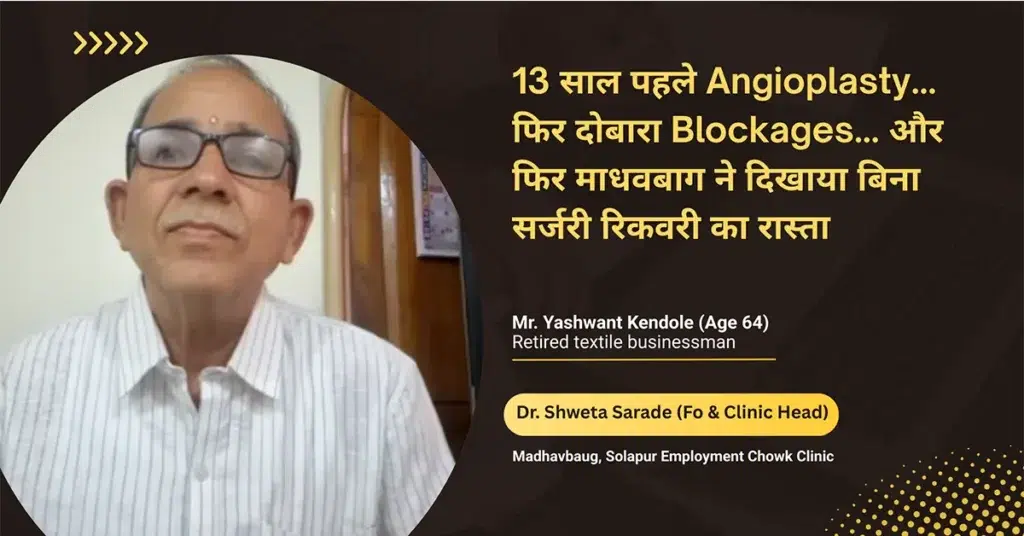
Angioplasty ke 13 saal Baad Dobara Heart Blockage, दवाओं पर निर्भर ज़िंदगी और फिर बिना सर्जरी दिल की रिकवरी — यह वास्तविक केस स्टडी बताती है कि सही मेडिकल मार्गदर्शन और डॉक्टर की निगरानी में हार्ट रिवर्सल संभव हो सकता है। “मुझे लगा अब फिर से ऑपरेशन ही आख़िरी रास्ता है… लेकिन माधवबाग ने बिना सर्जरी दिल की सेहत वापस ला दी।” Angioplasty ke 13 saal Baad Dobara Heart Blockage: Bina Surgery Recovery एक वास्तविक केस स्टडी “13 साल पहले जब पहली बार सीने में दर्द हुआ, डॉक्टर ने एंजियोग्राफी की और कहा — ब्लॉकेज हैं, एंजियोप्लास्टी करनी पड़ेगी। उस समय बिना ज़्यादा सोचे मैंने ऑपरेशन करवा लिया… क्योंकि ज़िंदा रहना ज़रूरी था।” यह कहानी है श्री यशवंत केंडोले (आयु 64 वर्ष) की — सोलापुर के एक सेवानिवृत्त टेक्सटाइल व्यवसायी, जिन्होंने अपना अधिकांश जीवन काम और परिवार को समर्पित किया। लेकिन ज़िंदगी ने एक बार फिर उनके दिल की परीक्षा ली। रोगी की जानकारी नाम: श्री यशवंत केंडोले आयु: 64 वर्ष क्लिनिक: माधवबाग सोलापुर – एम्प्लॉयमेंट चौक चिकित्सक: डॉ. श्वेता सारडे (B.A.M.S, Fellowship in Preventive Cardiology, 16+ वर्ष अनुभव) निदान: Post-PTCA IHD, मधुमेह उपचार पैकेज: IRP-1 Reverse Diet Box नामांकन तिथि: 10-09-2023 13 साल बाद फिर लौटी परेशानी एंजियोप्लास्टी के बाद यशवंत जी कुछ समय के लिए ठीक थे, लेकिन उनकी ज़िंदगी दवाओं पर निर्भर हो गई थी — ब्लड थिनर, बीपी और शुगर की गोलियाँ रोज़मर्रा का हिस्सा बन गईं। 2023 में उन्हें फिर से ये लक्षण महसूस हुए: सीने में दर्द बाएँ हाथ में दर्द लगातार थकान यह डर — “कहीं फिर से ब्लॉकेज तो नहीं?” जांच के बाद पुष्टि हुई — दिल की नसों में ब्लॉकेज दोबारा बन चुके थे। डॉक्टर ने फिर से एंजियोप्लास्टी की सलाह दी। टर्निंग पॉइंट – “इस बार ऑपरेशन नहीं” इस बार यशवंत जी ने रुकने का निर्णय लिया। “पहले एंजियोप्लास्टी करवा ली थी… लेकिन अब दोबारा शरीर में स्टेंट डलवाना मुझे स्वीकार नहीं था।” एक परिचित के माध्यम से उन्हें माधवबाग के बारे में जानकारी मिली — जहाँ heart blockage treatment के लिए डॉक्टर की निगरानी में नॉन-सर्जिकल उपचार अपनाया जाता है। यहीं से उनकी रिकवरी यात्रा की नई शुरुआत हुई। माधवबाग में शुरू हुई हीलिंग प्रक्रिया सोलापुर एम्प्लॉयमेंट चौक क्लिनिक में उनका संपूर्ण मेटाबॉलिक और कार्डिएक मूल्यांकन किया गया। इलाज से पहले की स्थिति वज़न: 65 किलोग्राम BMI: 27 HbA1c: 6.5 VO₂ Max: 18.38 EF: 45% स्ट्रेस टेस्ट: पॉज़िटिव दवाएँ: अनेक डॉक्टर-सुपरवाइज़्ड इंटीग्रेटेड प्रोटोकॉल पंचकर्म आधारित डिटॉक्स रिवर्स डाइट थेरेपी हृदय-सुरक्षित व्यायाम मधुमेह और बीपी नियंत्रण तनाव प्रबंधन दवाओं का संतुलन यह पूरा उपचार heart blockage treatment without surgery के सिद्धांतों पर आधारित था। 90 दिनों में दिल ने फिर साथ दिया EF: 45% → 60% VO₂ Max: 18.38 → 35.7 स्ट्रेस टेस्ट: पॉज़िटिव → नेगेटिव दवाएँ: अनेक → बंद परिणाम: IHD रिवर्स हुआ, एंजियोप्लास्टी से बचाव हुआ। रोगी की आवाज़ “मैं सिर्फ दिल के इलाज के लिए आया था… लेकिन यहाँ आकर मेरी पूरी ज़िंदगी बदल गई। आज मैं बिना सर्जरी और बिना गोलियों के जी रहा हूँ।” डॉक्टर की राय “पोस्ट-एंजियोप्लास्टी रोगियों में मेटाबॉलिक सुधार और पंचकर्म आधारित उपचार से हृदय की कार्यक्षमता में चिकित्सकीय सुधार देखा जा सकता है।” यह केस स्टडी क्यों महत्वपूर्ण है? यह कहानी उन लोगों के लिए है जो मानते हैं कि एंजियोप्लास्टी के बाद कुछ नहीं बदला जा सकता। सही मार्गदर्शन में बदलाव संभव हो सकता है। मेडिकल-सेफ सलाह यदि आपको सीने में दर्द या सांस फूलने की शिकायत है, तो पहले अपने हृदय रोग विशेषज्ञ से परामर्श अवश्य करें। मेडिकली स्थिर होने पर ही किसी वैकल्पिक उपचार पर विचार करें। भारत भर में क्लिनिक | अपॉइंटमेंट द्वारा परामर्श अंतिम संदेश: “एंजियोप्लास्टी के बाद भी ज़िंदगी बदली जा सकती है।” Clinic Details Treatment is given at the Ayurvedic Clinic in Solapur Employment Chowk. This is a top Ayurvedic cardiac care center. It is known for managing heart blockages without surgery. The clinic also offers research-based lifestyle therapies. Looking to visit us in person? 📍 Madhavbaug – Ayurvedic Cardiac Care Clinic & Panchakarma Center (Employment Chowk, Solapur) on Google Maps and plan your visit with ease.यदि आप एंबरनाथ के बाहर हैं, तो भी नज़दीकी क्लिनिक में अपॉइंटमेंट बुक कर सकते हैं। 🔎 Find a Madhavbaug Clinic Near You and begin your heart-health recovery journey naturally with expert-guided Ayurvedic cardiac care. Nationally Honoured & Media-Featured Leader in Heart Blockage Care Madhavbaug has earned national recognition for its contributions to non-surgical cardiac care and lifestyle-based disease reversal. The organization has been featured across major media for its clinical research and high-impact public health initiatives.In 2018, Madhavbaug reached a big milestone in the India Book of Records. They did 661 live GTT assessments in one day at many clinics. This achievement was reported by major news platforms. In 2023, Madhavbaug further strengthened its clinical authority by training 65 government medical officers in Uttarakhand on evidence-based, Ayurveda-integrated disease reversal protocols.Madhavbaug has received over 200 awards. These awards are for excellence in healthcare, innovation, and patient outcomes. Madhavbaug is one of the most trusted names in heart blockage treatment without surgery in India.
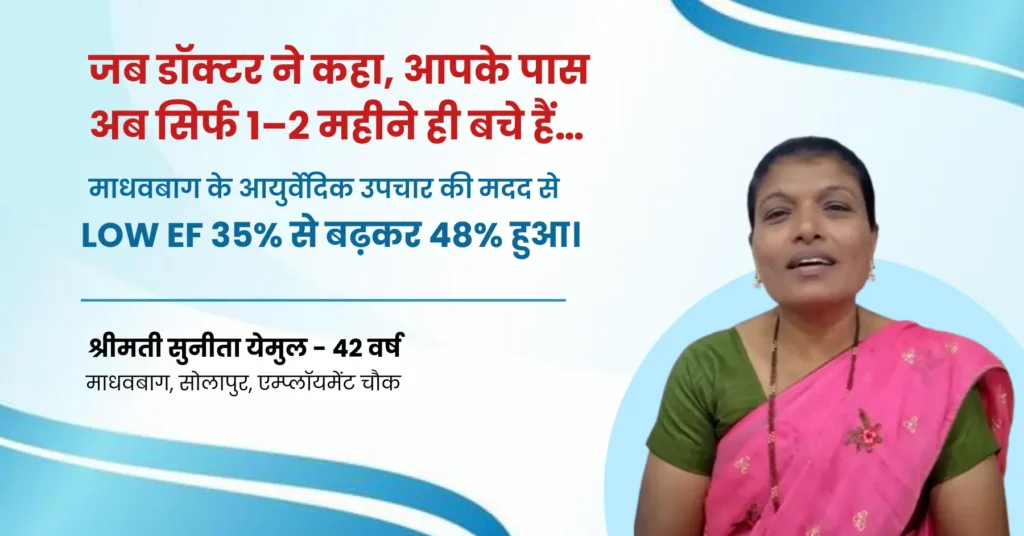
“जब डॉक्टर ने कहा – आपके पास शायद सिर्फ 1–2 महीने बचे हैं…” उस पल एक माँ के सामने सिर्फ एक ही सवाल था — क्या वह अपने बच्चे को बड़ा होता हुआ देख पाएगी? यह Post Pregnancy Low EF Heart Failure Recovery Case Study एक वास्तविक, clinically monitored और emotionally powerful कहानी है, जो बताती है कि सही heart blockage treatment और doctor-guided cardiac rehabilitation से कुछ medically stable मामलों में functional improvement संभव हो सकता है। Real patient | Real post-pregnancy heart failure journey Low EF 35% से 48% तक clinically monitored improvement Non-surgical, doctor-supervised cardiac care Mother-centric recovery story “डॉक्टर ने कहा था — आपके पास शायद सिर्फ 1–2 महीने बचे हैं। उस पल मेरी आँखों के सामने सिर्फ मेरा छोटा सा बच्चा और मेरा परिवार था…” यह कहानी है Mrs. Sunita Yemul (Age 42) की — Solapur से — जिन्होंने post-pregnancy Low EF, heart failure और varicose veins जैसी जटिल स्थितियों के बावजूद जीवन की ओर दोबारा कदम बढ़ाया। यह Post Pregnancy Low EF Heart Failure Recovery Case Study किसी दावे का नहीं, बल्कि medically supervised journey का दस्तावेज़ है। Patient Profile – Post Pregnancy Low EF Heart Failure Case Name Mrs. Sunita Yemul Age 42 Years Clinic Madhavbaug Solapur – Employment Chowk Treating Doctor Dr. Shweta Sarade (Clinic Head) B.A.M.S, 16+ Years Experience Diagnosis Post-Partum DCM, Low EF, Varicose Veins Program HERT-2 जब माँ बनने के बाद दिल कमजोर पड़ने लगा Sunita ji IVF के माध्यम से माँ बनी थीं। Baby के जन्म के कुछ समय बाद उन्हें chest heaviness, सांस फूलना, कमजोरी और पैरों में varicose veins की समस्या शुरू हो गई। 2D Echo में EF सिर्फ 35% पाया गया — साथ ही globally hypokinesia और dilated chambers जैसे changes दिखे। यह वो मोड़ था जहाँ Post Pregnancy Low EF Heart Failure Recovery एक medical challenge बन चुका था। जब हर विकल्प खत्म होता दिखा Sunita ji ने कई hospitals और specialists से consult किया। IV medicines चलीं, investigations हुए, लेकिन हर जगह एक ही जवाब मिला — “Case complicated है… options limited हैं।” उन्हें टूटने से सिर्फ एक चीज़ रोक रही थी — उनका बच्चा। यही विश्वास उन्हें Madhavbaug तक ले आया। Turning Point – Madhavbaug Cardiac Care Madhavbaug Solapur Clinic में उनका detailed cardiac और metabolic assessment किया गया। यहाँ heart blockage treatment without surgery जैसे lifestyle-based cardiac programs medically stable patients के लिए explore किए जाते हैं। Madhavbaug Treatment Approach (Doctor-Supervised) Panchakarma based cardiac detox Heart-safe diet protocol Varicose veins care Stress & sleep correction Medication rationalisation (cardiologist guidance) Clinical Changes Over 90 Days Parameter Before After EF 35% 48% Weight 78.15 kg 70.12 kg VO₂ Max 16.98 20.18 NT-proBNP 274 Normalised *All outcomes were monitored clinically. Individual results may vary. Patient’s Voice “मुझे लगा मैं अपने बच्चे को बड़ा होता नहीं देख पाऊँगी… आज मैं खुद चल सकती हूँ, हँस सकती हूँ और माँ होने का हर पल जी रही हूँ।” Doctor’s Clinical Insight Dr. Shweta Sarade: “Post-partum cardiomyopathy एक high-risk condition है। Sunita ji का improvement doctor-supervised Panchakarma-based lifestyle correction के साथ clinically observed हुआ।” Why This Post Pregnancy Low EF Heart Failure Recovery Case Study Matters Post-pregnancy symptoms को ignore नहीं करना चाहिए Low EF हमेशा hopelessness नहीं होता Doctor-guided lifestyle correction कुछ मामलों में supportive role निभा सकती है अगर pregnancy के बाद chest pain, breathlessness या weakness महसूस हो रही है — तो तुरंत cardiologist से evaluation कराएँ। Medically stable होने पर Madhavbaug के supervised cardiac rehabilitation programs explore किए जा सकते हैं। 🏥 Madhavbaug Clinics Across India | 📞 Book Consultation “जब माँ स्वस्थ होती है, तभी पूरा घर स्वस्थ होता है।” Award-Winning, Media-Recognized Leader in Diabetes Reversal Madhavbaug is widely recognized for its pioneering research and large-scale impact in diabetes reversal. In 2018, the organization set an India Book of Records by conducting 661 live GTT events simultaneously across multiple clinics — a feat covered by PR Newswire. In 2023, Madhavbaug conducted scientific, evidence-based disease-reversal training for 65 government doctors in Uttarakhand, highlighting its clinical authority and national credibility. The organization has also received over 200 healthcare awards for medical innovation and patient outcomes, strengthening its leadership position in the field. Clinic Details Treatment provided at Madhavbaug Clinic in Solapur (Employment Chowk), a leading Ayurvedic cardiac care center known for its non-surgical heart blockage management and research-based lifestyle therapies. Looking to visit us in person? 📍 View Madhavbaug – Ayurvedic Cardiac Care Clinic & Panchakarma Center (Employment Chowk, Solapur) on Google Maps and plan your visit with ease.यदि आप एंबरनाथ के बाहर हैं, तो भी नज़दीकी क्लिनिक में अपॉइंटमेंट बुक कर सकते हैं। Find a Madhavbaug Clinic Near You and begin your heart-health recovery journey naturally with expert-guided Ayurvedic cardiac care. Frequently Asked Questions in Post Pregnancy Low EF Heart Failure 1. What causes postpartum heart failure? Postpartum heart failure most commonly occurs due to post-partum cardiomyopathy (PPCM), a condition where the heart muscle becomes weak during the last month of pregnancy or within a few months after delivery. Possible contributing factors include: Hormonal changes after pregnancy Increased cardiac workload during pregnancy Inflammation or immune response affecting the heart muscle Nutritional deficiencies High blood pressure during pregnancy (pre-eclampsia or eclampsia) Genetic or metabolic susceptibility The exact cause is often multifactorial and not always clearly identifiable. 2. How common is pregnancy-induced heart failure? Pregnancy-induced heart failure, including postpartum cardiomyopathy, is considered rare, but clinically significant. Estimated to occur in approximately 1 in 1,000 to 1 in 4,000 pregnancies, depending on population and risk factors. Higher risk has been observed in women with: Multiple pregnancies Advanced maternal age Pregnancy-related hypertension Nutritional or metabolic disorders Early diagnosis is important, as symptoms may initially resemble normal post-pregnancy fatigue. 3. What does postpartum heart failure feel like? Postpartum heart failure symptoms can be subtle initially and may feel similar to routine post-delivery exhaustion. Common experiences reported by patients include: Persistent breathlessness, even at rest Extreme or unexplained fatigue Chest discomfort or heaviness Difficulty lying flat due to shortness of breath Swelling in legs, ankles, or feet Palpitations or irregular heartbeat Because these symptoms overlap with normal postpartum recovery, medical evaluation

