Triglyceride-Glucose Index: Insulin Resistance and Heart Risk
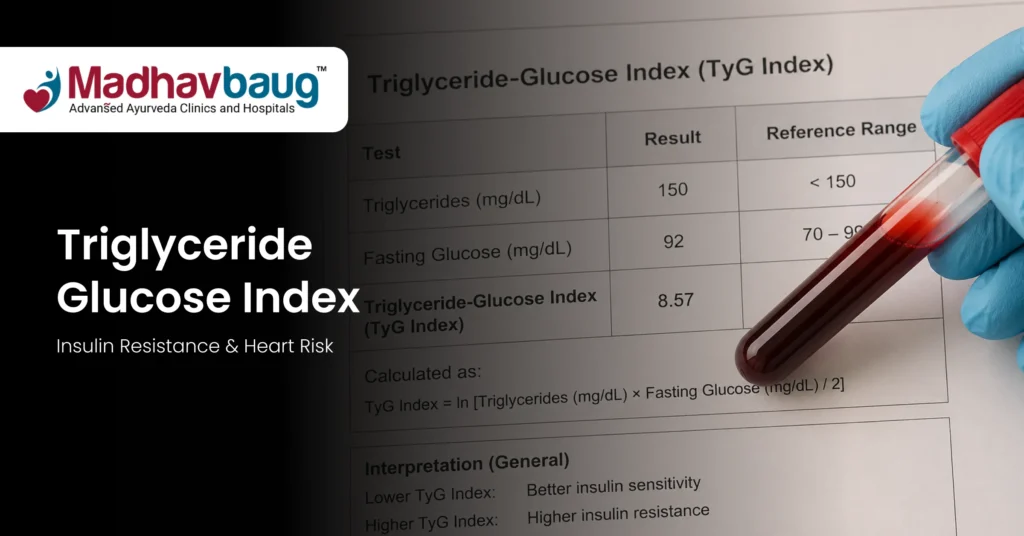
Cholesterol and blood sugar reports can look normal on their own, yet there may be a risk for developing diabetes or heart disease. That is because these two numbers can hide a problem when checked separately but become visible once they are looked at together. This is what the triglyceride-glucose index is designed to catch. At Madhavbaug, the Triglyceride-Glucose Index (TyG) is taken seriously and is treated as a starting point to make necessary changes rather than waiting till full diabetes develops, an approach backed by the brand’s own published research and clinical trials. This guide explains what the TyG index measures, how it connects to insulin resistance and heart health, and why the cut-offs are not something you should interpret on your own. What Is the Triglyceride-Glucose Index? The TyG index combines two values from a routine blood test, your fasting triglyceride level and your fasting blood glucose level, into a single number. Triglycerides are a type of fat in your blood. When triglyceride levels stay high for too long, along with high blood sugar, it can signal that your body may indicate an imbalance in insulin. The TyG index was first developed as a simple alternative to more complex insulin resistance tests (Guerrero-Romero et al., 2010), since fasting triglycerides and fasting glucose are already part of a standard blood test. The calculation itself is something your doctor or lab will handle, not something you need to do yourself. What makes the TyG index useful is that it brings these two values together to give a fuller picture of how your body is handling sugar and fat, rather than looking at either one alone. It is worth being clear that the TyG index is used only for screening and is not a diagnostic tool. A raised result is a signal to discuss further testing with a doctor, not a confirmation of any specific condition. How the TyG Index Relates to Insulin Resistance A raised TyG index usually points to insulin resistance. In simple terms, this means your cells stop responding to insulin, so the body keeps making more of it just to maintain blood sugar levels. If this goes on for too long, it can raise your risk for type 2 diabetes and heart disease. Triglycerides and blood sugar tend to rise together. When the body becomes insulin resistant, the liver makes more triglycerides, and blood sugar gets harder to control. Checking both together, instead of just one, gives a clearer picture of what is actually going on. Studies have confirmed that the TyG index is a reliable screening tool for insulin resistance and can perform really well when compared to standard tests (Chauhan et al., 2026). Who Should Pay Attention to the TyG Index? A few groups tend to come across this index more than others, mostly after a routine blood test. It includes people with: A family history of diabetes Borderline or high triglycerides on an otherwise normal blood report Extra weight around the belly Ongoing treatment for high blood pressure or early heart disease For this last group, the TyG index is often checked as part of a wider picture, since a doctor managing diabetes, blood pressure or heart disease is usually looking at several blood results together, given how closely these conditions overlap. What Are the Limits of the TyG Index, and Why Do Cut-Offs Vary? Unlike a blood pressure or blood sugar reading, the TyG index does not come with one universal cut-off that applies to everyone. Research shows that TyG values above roughly 4.5 to 4.7 can be a warning sign, and one should consult a doctor if that is the case. At the same time, it is important to understand that studies have proposed different values for raised results, and these can change in different settings (Sánchez-García et al., 2020). What can affect TyG cut-offs Why it matters Population studied Cut-offs developed in one country or group may not be the same for others Laboratory methods Small differences in how triglycerides and glucose are measured can change the result Body weight and existing conditions Underlying health factors can impact the results Because of this variation, the same TyG number can mean different things for different people. A doctor interpreting the result will usually weigh it against your overall health profile, rather than comparing it to a single fixed number. Triglycerides, Glucose and Heart Risk When triglycerides and blood sugar remain high together for a longer period, they place extra strain on blood vessels, which can raise heart disease risk. A study following patients with high blood pressure (Dakota et al., 2025) found that a higher TyG index was linked to a greater chance of heart attack and stroke. Similarly, another study (Moon et al., 2023) found that a rising TyG index predicted future heart disease. This is why the TyG index has now found its place in heart disease screening, which is also why understanding and preventing heart disease often means looking at tests like this one well before symptoms appear. Tests to Discuss With Your Doctor The TyG index works best as a starting point and not a final result. If your number looks raised, a few follow-up tests can help get a clearer picture before deciding on next steps. Test What it checks HbA1c Average blood sugar over the past three months Fasting blood sugar test Blood sugar levels after an overnight fast Fasting lipid profile Triglycerides, high-density lipoprotein (HDL), and low-density lipoprotein (LDL) levels in detail Fasting insulin (if available) A more direct insulin resistance test Blood pressure check Since insulin resistance is often linked to high blood pressure A doctor will usually look at the results and will also consider your weight, waist size, and family history, rather than relying on any single number. This combined view, the same approach used across diabetes, hypertension, and heart disease care at Madhavbaug, is what makes early care possible before complications develop. If your reports come back with a few