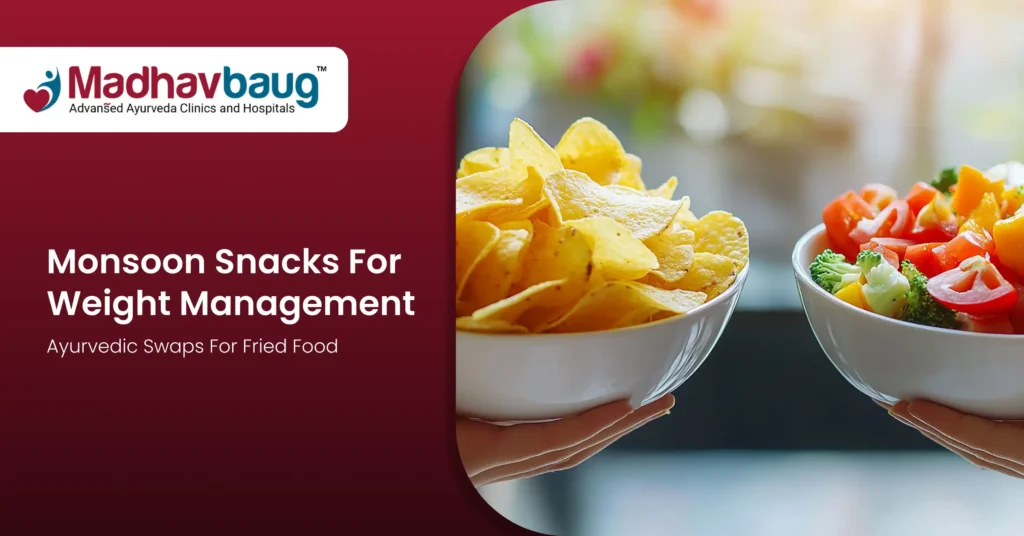
As soon as it rains, our first thought is to sit by the window with a bowl of Maggi or fritters (pakoras) and enjoy. But the question here is, is it really delightful for the gut? Our gut consists of good bacteria, which are responsible for proper digestion. Intake of junk food or processed oil destroys the good intestinal bacteria, further causing leaky gut and leading to lifestyle disorders such as obesity. In Ayurveda, Ahara, as in food, is one of the three sub-pillars that is responsible for better health. Healthy monsoon snacks can be a better alternative to fried food in order to have a healthy gut. At Madhavbaug, we promote eating healthy alternatives and have developed kits for healthy food, which helps reduce weight, boosts energy, and promotes better health through balanced nutrition. We focus on holistic healing through food, regimen, panchakarma, and supplements, addressing the proper root cause. Why Do Cravings Rise In Monsoon? Desire for food is usually regulated by the brain. During monsoon, there is a lack of sunlight. Studies suggest that lack of sunlight is interlinked with a hormone called “serotonin,” which is secreted by the brain (Lambert, G.W., 2002). A decrease in serotonin leads to a gloomy mood, which in turn leads a person to eat more spicy and tangy food in order to feel pleasant. Due to rains, people tend to stay indoors, due to which snacking habits may develop more, leading a person to eat more than their regular appetite. With this, lack of physical activity leads a person to slowly gain weight. Calorie, Salt and Sugar Traps Consuming more salt and sugar directly leads to weight gain. It not only disturbs the digestive system but also affects other systems such as the circulatory system and even the excretory system, leading to an impaired metabolism. Let us understand in detail: How Excess Salt Increases Weight High-salt diets are directly linked with an increase in the amount of fat cells in the body. It also makes the fat cells denser. (Lyssie Lakatos, R.D., 2009) Kidneys are the organs responsible for the excretion of water along with sodium. A high-salt diet puts more pressure on kidneys. After a certain point, a threshold has been reached after which there is excess salt deposition and damaged cells. Since more sodium is excreted, less water is excreted, which leads to water retention, further leading to bloating. Excess salt even hardens the arteries, which leads to a decrease in oxygen supply. Less oxygen means a decrease in metabolism and less fat burned overall. How Excess Sugar Increases Weight.. Consuming excess sugar can lead to an increase in fructose in the body without decreasing the other sources of energy. This leads to an increase in the number of cells, leading to weight gain. This may seem simple, but all the packaged and junk food and even beverages include high sugar levels. When the snacking habit increases during the monsoon, all these consumption increases causing weight gain and even obesity. Smart Portion Formula As you read, it becomes difficult to control cravings during the monsoon; a smart portion formula could be a rescue. It is a formula designed to have balanced meals without weighing ingredients every now and then. It can be followed in two ways: Ayurveda-Informed Taste and Digestion Principles Ayurveda is a holistic science that states that the body fundamentally comprises Vata, Pitta, and Kapha elements. Vata is the one that is, moreover, responsible for the overall regulation of the body and the transportation of substances within the body. Vata, along with Pitta, is responsible for digestion, and Vata, along with Kapha, is responsible for taste. In Varsha Ritu, which is the monsoon, Vata naturally increases in everybody’s body due to increased wind and humidity. This leads to a natural aggravation of Vata, which affects the taste and the digestion of the body. This means since digestion is a bit difficult during this season, one should consume food that is laghu (easy to digest), such as boiled moong, and that is snigdha (unctuous in nature), such as ones that have unsaturated fats. 10 Indian Weight Loss Snack Swaps It is very difficult to control one’s cravings, but healthy monsoon snacks are a good solution to balance both health and taste. Let us see the top 10 healthy snack swaps: Unhealthy snacks Healthy alternatives Wrap Contains: Maida Processed Sauces and Vinegar Moong dal chilla wrap Contains: Moong dal (high protein and easy to digest) Freshly baked without preservatives French Fries Contains: Potato Healthy Fries Contains: Yam/Sweet Potato/Carrot Coke Contains: Carbonated Dhanyaka Hima Contains: Coriander seeds, which naturally cools down the body Burger Contains: Maida Potato patty Processed Sauces and Vinegar Healthy Burger Contains: Millet bread Yam patty Fresh and sautéed vegetables Maggi Contains: Madia Preservatives Healthy noodles Contains: Noodles made from millets (jowar or ragi) No added preservatives Pakora Contains: Oily Healthy Pakora Contains: No oil (air-fried) or consume it in form of roasted chips Cupcakes Contains: Harmful sugar Narikela Khanda Contains: Rock candy, which is healthy White Paste Contains: Maida Preservatives Wheat Pasta Contains: Wheat Vegetables such as broccoli, zucchini, etc. Mayonnaise Contains: Processed and preservatives Avacado Contains: Fresh and no vinegar Ice cream Contains: Excess Sugar Unhealthy fat (Saturated) Oat meal Contains: Natural sweeteners No added preservatives With this, there can be many Ayurvedic snacks for weight loss. Madhavbaug has created a swasthyam kit, which has meals that are easy to digest and help reduce weight. Madhavbaug’s Solution for Weight Gain Madhavbaug has a unique approach for obesity that works on root causes rather than just losing weight. Their holistic approach includes a combination of Panchakarma, diet, and exercise. With this, we have an integrated approach, including the MIB app, which is helpful for regular monitoring. Panchakarma Through Panchakarma procedures, the toxins of the body are flushed out, and a natural detox
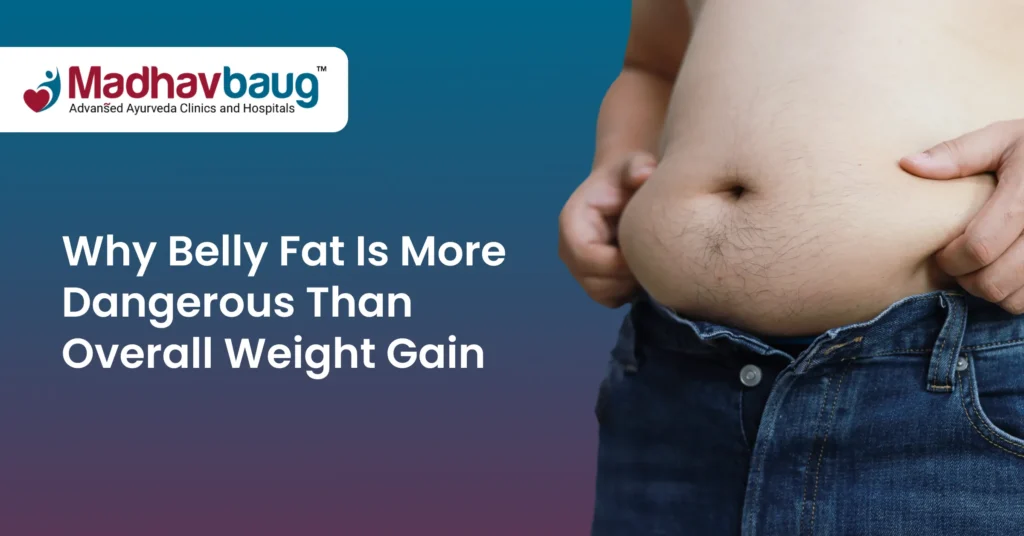
Which is more dangerous, belly fat or overall weight gain? Find out why belly fat is more dangerous than overall weight gain. Discover obesity causes, excess weight gain risks, and how to reduce belly fat naturally with Madhavbaug. When it comes to weight loss, most people fixate on the scale. But modern metabolic science and Ayurveda disagree,where you store fat matters far more than how much you weigh. You could have a normal BMI yet still carry dangerous fat around organs, a condition known as metabolic obesity, or being “skinny fat”. At Madhavbaug, our focus is on addressing the root cause of metabolic imbalance and not on treating what is visible on the surface. Understanding the real risks that carrying belly fat creates is one of the most important steps in protecting your health long-term. Why Is Belly More Dangerous? Not all fat is the same. Subcutaneous fat (the kind you can pinch) is relatively harmless. The fat around your organs like the liver, pancreas, and intestines is collected as visceral fat. This visceral fat can act like an active organ, at times, releasing inflammatory chemicals and hormones directly into your bloodstream. What many people may not realise is that this can throw your hormones off balance and can, over time, seriously raise your risk of chronic lifestyle disorders, even if your total body weight appears normal on the weighing scale. What are the Key Health Risks Linked to Obesity-Related Belly Fat? Excess abdominal fat can trigger a wide range of metabolic damage: Type 2 Diabetes Visceral fat may impair the functioning of insulin, in turn, causing the pancreas to work more and produce a spike in blood sugar levels (Kahn et al., 2001). Heart Disease A rise in LDL cholesterol and triglycerides, triggered by the release of free fatty acids by the fat around your organs, can act as a direct cause for arterial plaque. (Alexopoulos, Katritsis and Raggi, 2014; Lafontan and Girard, 2008). Chronic Inflammation Inflammation can result in a number of disorders & diseases. Inflammatory proteins from abdominal fat may cause damage to your blood vessels, leading to a rise in blood pressure (Alexopoulos, Katritsis and Raggi, 2014). Fatty Liver Disease Excess fat that may deposit in the liver can cause disrupted detoxification and slow metabolism (Lafontan and Girard, 2008). What Are Some Common Causes Of Abdominal Obesity? Understanding abdominal obesity causes is essential for lasting results in obesity reversal or treatment: High-sugar and processed food Processed foods, sugary drinks, and trans fats can lead to the accumulation of visceral fat, especially in the abdominal area. Lifestyle factors Sitting for long hours can slow your metabolism and encourage fat storage in the midsection. Long-term stress and cortisol Chronic stress leads to an elevation in cortisol levels, signalling the body to deposit fat deep in the abdomen. Ayurvedic perspective (Kapha imbalance) Sluggish Agni (digestive fire) leads to Ama (toxin) accumulation, disturbing Meda Dhatu (fat tissue) and driving abdominal weight gain (Bhardwaj and Kukkal, 2022). How to Reduce Belly Fat Naturally? Simple calorie restriction may not be enough; losing visceral fat requires a strategic approach. Do’s Don’ts Eat soluble fibre: millets, oats, leafy greens, legumes Avoid liquid calories: sodas, packaged juices, sugary drinks 30–45 mins of brisk walking or yoga daily Don’t skip sleep; under 7 hours spikes cortisol Use Ayurvedic herbs: Triphala, Guggul, Methi Avoid late-night heavy meals How to Measure If You Have Dangerous Belly Fat? Most people wait until they feel unwell before investigating their metabolic health. But belly fat dangers can be silently building long before any symptoms appear. Knowing how to assess your own abdominal fat at home gives you an early warning and a reason to act sooner. Waist Circumference Wrap a measuring tape around your bare abdomen, just above your hip bone. Do not suck in your stomach. For the Indian population, the risk thresholds are: Men: Waist circumference above 90 cm (35 inches) indicates increased abdominal obesity risk Women: Waist circumference above 80 cm (31 inches) signals elevated visceral fat risks These cutoffs are lower than Western standards because research consistently shows that South Asians accumulate fat around organs at lower overall body weights (Misra and Khurana, 2011), making vigilance even more critical. Waist-to-Hip Ratio Divide your waist measurement by your hip measurement. A ratio above 0.90 for men and 0.85 for women is considered high risk by the World Health Organization (World Health organisation, WHO, 2011). This measure is more reliable than the scale alone because it captures fat distribution, not just total weight. Why BMI Alone Can Be Misleading BMI does not distinguish between muscle mass and fat, nor does it reveal where fat is stored. This is exactly why metabolic obesity, carrying dangerous fat around organs despite a “normal” BMI, often goes undetected for years. Two people with identical BMI scores can have vastly different visceral fat levels and health risks (Han, Sattar and Lean, 2006). When Should You See a Specialist? If your waist measurement is creeping upward even without noticeable weight gain, or if you fall within the high-risk ranges above, do not wait. These are early signals of underlying metabolic imbalance that respond far better to treatment when caught early. Consult an obesity specialist by visiting your nearest Madhavbaug clinic for a comprehensive metabolic assessment. Madhavbaug’s Non-Surgical Weight Loss Treatment Stubborn abdominal fat won’t respond to crash diets. You need a medically supervised weight loss treatment that addresses the root cause. Madhavbaug’s Ayurveda-integrated approach to obesity includes the following: Customised Diet Our experts at Madhavbaug design customised low-glycaemic and cardioprotective meal plans to help you burn your stored visceral fat (Lange and Pałkowska-Goździk, 2025). Panchakarma Therapies like Udwarthanam clear the ama and can boost your local fat metabolism. This leads to quicker fat burning (Mishra et al., 2024). Therapeutic yoga & pranayama Kapalbhati and anulom vilom help reduce cortisol and activate your abdominal organs (Sharma et al., 2014). Medical supervision Expert doctors monitor blood pressure, metabolic health, and cardiac markers throughout your journey using Madhavbaug’s technologically advanced monitoring apps

Angioplasty के बाद भी डर बना रहा… पर Ayurveda ने मुझे फिर से जीना सिखाय
A Real Heart Blockage Recovery Story | Non-Surgical Ayurvedic Treatment

